
Wheelchairs are absolute game changers for people with mobility issues, but by themselves, they still impose limits, and limits can be frustrating.
For example, let’s say you’ve got a decent manual wheelchair. It lets you roam around your house freely and even putter around your yard when you’re feeling up to it. Those are great things, but what happens when you want to go to the store?
Unless it’s just down the block, it’s probably too far to wheel your way to and from the store, so you’ll need to stow your chair in a vehicle of one sort or another to get it where you want to go.
Maybe it’ll fit in the trunk of your car, and maybe it won’t. You can buy some other type of wheelchair-accessible vehicle like a truck or an SUV to give yourself more storage space. If you’re going to do that, why not get a vehicle that’s specially designed to accommodate wheelchairs, scooters, and power chairs?
If you’re considering buying a wheelchair-accessible van, this article will shed some light on the various factors to consider in order to help guide you to the perfect van for you.
If that sounds good, read on, and let’s take a closer look!
Initial Considerations

The very first thing to say is that for this article, we’ll be considering buying something new, rather than buying a used van that someone else has converted. The reason is this:
While it is possible to find a used van that’s in decent shape, conversions tend to be highly individualistic. So if you buy a van that someone else has converted, in addition to doing your due diligence regarding the engine, the transmission, and the overall condition of the van, you’ll also have to take careful measurements to be sure that the conversions will be of use to you.
There’s also the fact that most conversion vans tend to be used until the wheels fall off, so you’ll want to go over a used van with a fine-toothed comb. Better yet, bring a certified mechanic with you to make sure there aren’t any hidden issues.
With those things said, let’s take a look at your options.
Different Types of Wheelchair Accessible Vans
Broadly speaking, there are three basic types or styles of accessibility vans to consider:
Lowered-floor, Raised Roof, or full-sized. We’ll take a look at each one in turn.
Lowered-Floor Minivans
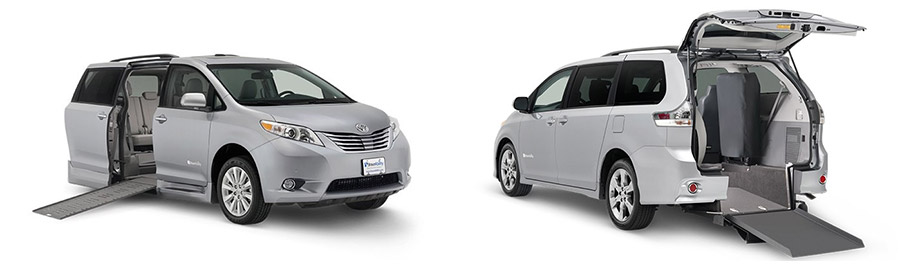
Minivans are wildly popular in the mainstream market because they’ve got plenty of room, they’re surprisingly economical and versatile, and they’ve got a sporty enough look about them to be appealing to many different market segments.
Most of the minivan’s design strengths also make it a great fit for those with mobility issues. Minivans are just easy to work with when it comes to loading and unloading wheelchairs and scooters, not to mention the fact that the open floor plan of the interior makes wheelchair navigation a relatively simple matter.
Parking is also easier with a minivan than with their full-sized counterparts, so it’s almost all good news.
In terms of accessibility conversions, there are a few different directions you could take if you’ve got a minivan to work with.
Most people tend to keep it simple, opting for a ramp system designed for side entry, helped along by a 10” lowered floor. When the conversion is done, most minivans will have some 58” of clearance, which is impressive indeed.
Even better, the lowered floor can be extended all the way forward, even allowing a person to drive while sitting in his or her wheelchair, which is incredibly convenient.
Unfortunately, it’s not all sunshine and roses. Although lowered-floor, side-entry minivans are delightfully practical, the engineering behind them is quite complex, and the process of actually building the conversions mentioned above is expensive. You’ll pay a hefty premium for all that convenience, which may put this type of conversion out of the reach of many.
The reason it’s so expensive has everything to do with the creation of the lowered floor, which requires cutting the main support beams running the length of the van and inserting a new subframe. In addition to that, the fuel tank will need to be relocated, which is a fairly expensive proposition all by itself.
The good news is that these types of conversions must comply with the Federal Motor Vehicle Safety Standards, so you can drive with confidence, knowing that the people who did your conversion did so with safety at the forefront of their minds.
That’s all well and good, but one unavoidable side effect of this type of conversion is the fact that your van won’t ride as smoothly, and you’ll face increased road noise.
Another minivan conversion option sees a ramp channel placed such that it runs down the length of the van, allowing for the wheelchair or scooter to be driven into the van from the back.
The biggest advantage this approach has is that the person using it can load and unload from almost any standard parking space. You won’t have to worry a bit about the vehicles on either side of you; they simply won’t factor into the equation.
On top of that, they tend to be somewhat less expensive since you’re not forced to cut the main frame of the van or relocate the fuel tank. That said, rear-entry minivan conversions do have a couple of drawbacks.
First, you lose the ability to drive while sitting in your wheelchair. If that’s not a huge deal to you, then you won’t really miss it. You’ll need to take a different approach if you have your heart set on that.
On top of that, the design requires that the wheelchair user backs out of the van, which can be a bit tricky, especially if you have a serious mobility issue, limited strength, or own a larger, more cumbersome wheelchair or scooter.
Finally, bear in mind that the most common type of traffic accident is the rear-end collision, which places a giant target on your expensive conversions that will increase your repair bill if you are hit from behind.
Raised Roof Vans
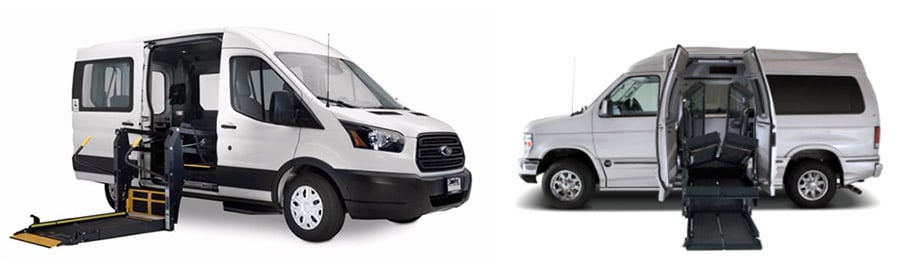
Raised roof vans are a subset that can be found in the ranks of both minivans and the full-sized models we’ll talk about below. They are somewhat less costly than other models, making them a good alternative for those looking for added headroom. Though as the name indicates, the floor here is higher than it is on the models we just discussed.
While a raised roof van can be a good option, you’ll almost certainly want to invest in a lift or a ramp to help you get your wheelchair into and out of it, which will eat away the cost savings associated with this variant. There’s also the overall height of the vehicle to consider: It may simply be too tall to fit inside your garage, so you’ll want to measure carefully!
Full-Sized Vans
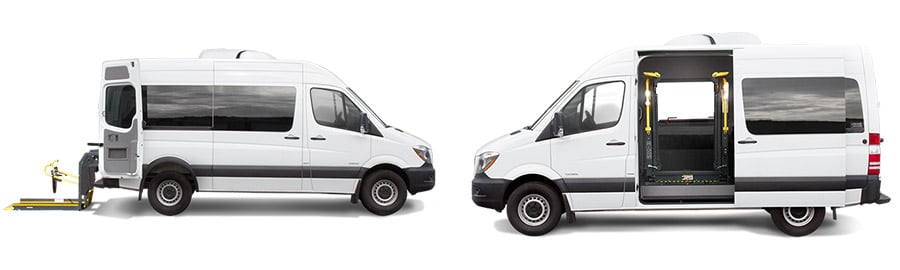
For those wanting a maximum amount of space to work with, including a floor to ceiling height of 56+”, a full-sized van is the way to go.
In fact, if you’re not particularly tall, a full-sized van with an 8” lowered floor could be ideal and may even allow you to drive while sitting in your wheelchair without needing an expensive modification, which could save you a ton of money.
No matter how you slice it, a full-sized van will give you more room to work with. It will give you more space to maneuver, more space for gear, and more space for a larger-sized wheelchair or scooter. Those are good things.
On the other hand, a full-sized van can be more challenging to drive and harder to park. They don’t fare as well in terms of fuel efficiency, making them relatively more expensive to own. As with everything else then, it’s a tradeoff.
How Much Does a Wheelchair Accessible Van Cost?

Let’s talk about money because for most people, that’s one of the biggest, if not the biggest, considerations. Here’s the short answer:
A conversion van will cost you anywhere from $20,000 to $70,000, depending on what you buy. Depending on what conversions you want to make, that will cost between $15,000 to $30,000.
The final answer to the question “how much are wheelchair accessible vans?” is between $35,000 to $100,000. That sounds like a lot, but it’s important to remember that the conversions you’ll want to make in order to make the van mobility-aid friendly require precise engineering, and you pay a premium for that.
How to Buy a Wheelchair Van

The van’s actual purchase is no different than purchasing any other vehicle, with the only possible exception being that you’ll want to take a few measurements to be sure that the van you purchase is a good fit for you and your power chair scooter or manual wheelchair.
The real trick is in finding a shop that can handle the conversions you’re interested in. The best way to find a reputable company is to search the National Mobility Equipment Dealers Association. Note that many auto dealers that sell conversion vans also have shops on site that can handle the conversion work but not all do.
Given that, you may wind up having to buy your van from a dealer, then find someone else to handle the conversions. That’s fine.
There are no “right” answers here, beyond what you can afford and what ultimately gets you a van with the capabilities you need.
How Much Does It Cost to Rent a Wheelchair Accessible Van?

Upon seeing the price tag associated with answering the question “how much does it cost to make a vehicle wheelchair accessible,” some people suffer a bit of sticker shock. They immediately shift gears by asking some variation of the question “Okay, so how much does it cost to rent a wheelchair van?”
It’s a fair question. As long as you don’t need one on a regular basis, renting may well be the best way to go.
Understand that prices will vary widely depending on what part of the country you live in and how long you rent the van in question, but here are a few general guidelines:
- Partial day rentals will cost you between $50-75 a day
- Renting for 1-6 days will cost you somewhere between $65-115 a day
- Renting for 7-20 days will cost you somewhere between $65-$100 a day
Final Thoughts on Buying Accessible Vans
Are you ready to buy a conversion van and make the necessary changes to it so that it serves as the flagship of your mobility aid technology suite, or are you content to simply try and make your existing car, truck, or SUV work, at least for now?
Both options are certainly viable. But if your budget allows it, investing in an accessible van will make your life a whole lot easier and give you relatively more freedom and flexibility than any other option out there.
Granted, you’ll pay a premium for that, but the people who have conversion vans swear by them. It’s an option worth giving serious consideration to.
Resources & References:
- Wheelchair Mobility, Sciencedirect.
- Wheelchair Accessible Van, Wikipedia.
- Walking Aids, Wheelchairs and Mobility Scooters, NHS.
- Practical Advantages of Wheelchair Accessible Vans, Patch.