
A sports wheelchair needs to be many things. It needs to be agile, fast, flexible, and above all, safe.
Oftentimes, athletes prioritize a sports wheelchair’s weight and design; however, one of the biggest impacts on performance is wheel and caster alignment.
In this guide, we share how to check if your wheelchair alignment is off and how to fix it so you can enhance performance and decrease the risk of injury. Let’s roll with it!
Sports Wheelchair Alignment Overview

It’s not uncommon to find that dealers and *gasp* manufacturers tend to ignore the importance of proper sports wheelchair alignment. It may seem like a small grievance, but this can make a crucial difference for athletes who want to perform at their peak with a reliable wheelchair.
Studies suggest that if one wheelchair component- let’s say the camber- is changed, that small shift can affect how the other components work.
When a wheelchair is out of alignment, it might lead to issues, such as increasing the rolling resistance, making it feel like you are constantly pushing uphill.
Correcting the alignment is one simple way to transform your sports wheelchair from a slug into a mighty stallion!
Here are some other benefits to fine-tuning alignment.
6 Benefits of Proper Wheelchair Alignment
Your sports performance isn’t the only thing affected by wheelchair alignment. It can have profound effects on health, as well.
- Posture improves, decreasing pain and tension in the shoulders, back, and neck.
- With less resistance, the user is not as tired and is more comfortable.
- The user is able to perform sports and other daily activities with increased vigor.
- The risk of falling out of the chair and sustaining injuries is lower.
- Better posture allows the user to breathe and swallow easier while improving digestion.
- Weight is more evenly distributed, lowering the risk of pressure ulcers and skin problems caused by bad posture and lack of movement in certain areas of the body.
How to Check Your Wheelchair’s Alignment
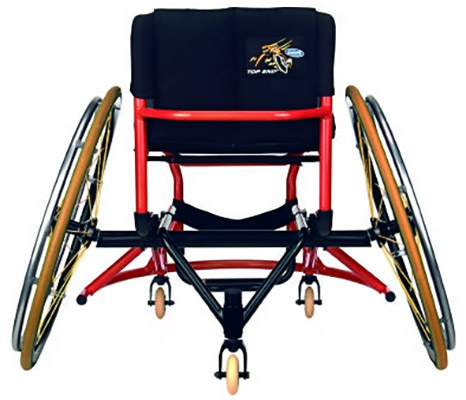
The good news is that you can check your wheelchair’s alignment yourself.
Start by measuring the distance between the tops of the rear wheels and the backrest. The measurement should be equal on both sides of the wheelchair.
If one wheel sticks out more than the other wheel, this signifies that the alignment is off, causing the chair to pull to one side.
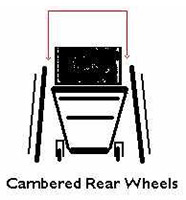
This is also called an unequal offset and can be fixed by adjusting the axle sleeve where the axle attaches to the frame.
Most chairs have an adjusting feature that moves the sleeve inward or outward. The sleeve can be moved to the preferred distance from the frame for a comfortable fit.
Bear in mind that the amount of camber and user weight can cause flexing, so it’s recommended to offset from 1 to 1 ½ inches.
The caster housing is another component to examine. It should be 90 degrees to the ground, which can be measured using a carpenter’s square, bubble level, or even the hard spine of a book.
If it’s off, check that your sports wheelchair has a bolt-on caster housing, which comes equipped with eccentric bolts, slots, or cams for adjusting the angle.
Toe-in and Toe-out
It’s time to discuss the king of all alignment mistakes, the one that even manufacturers tend to forget: toe-in and toe-out.
Let’s focus on the rear wheels for a moment. They are more or less the feet of the operation, and the wheels must point forward, just like feet, to function efficiently.
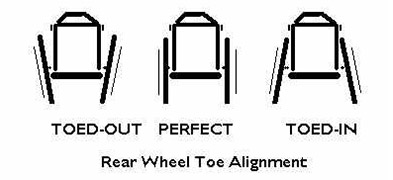
Have you ever heard the term “pigeon-toed” for feet that turn inward? That term mirrors “toe-in” for rear wheels. But if the wheels turn outward like a penguin, this is referred to as “toe-out.”
In other words, wheels that are toe-in or toe-out, even by just 2°, create rolling resistance. Wheels that are perfectly parallel facing forward are perfect and render the most efficiency while playing sports.
Rear-wheel misalignment is caused when the angle of the axle is changed, so it’s mounted on a chair with cambered wheels.
The camber makes it so that the wheels are closer at the top than at the bottom in regards to a 90-degree angle with the floor. But alas, for the camber to work properly, the axle mount must stay at that 90-degree angle.
Changing the wheelchair’s frame creates a domino effect that shifts the axle mount position and, therefore, changes the camber location.
For example, if you were to lower the rear of the wheelchair by adjusting the axle/camber plate up a couple of holes, the camber width shifts, resulting in the rear wheel width being slightly wider at the front, which is considered toe-out.
You can inspect your rear wheels for abnormalities by aligning them, so the two spokes are parallel with the floor as if positioned at 9 and 3 o’clock.
Next, measure from one wheel to the other then spoke to spoke. Measure between the farthest back edge on the wheels, following with a final measurement across the same span but at the front of the wheels.
If the alignment is perfect, the width measurements will be equal. If you come up with different widths, your chair is either toe-in or toe-out and must be corrected.
How to Correct Toe-In/Toe-Out Misalignment
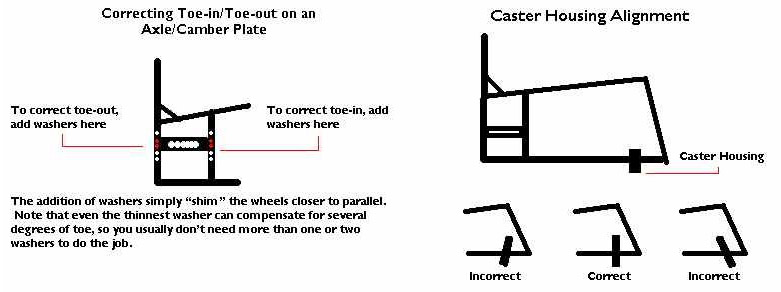
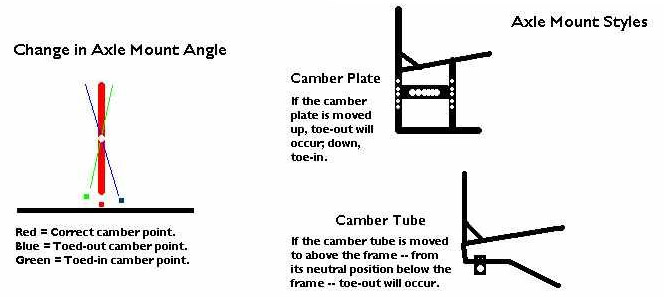
Correcting toe-in/toe-out requires adjusting the camber back so that it’s at 90 degrees again. You’ll have to start at the axle mount/camber plate by adding washers across from the side of the wheel that flares out.
You can also rotate the axle/camber tube forward to correct toe-out and backward to correct toe-in.
After the rear wheels are at 90 degrees, make one final check of the caster housings to ensure they also sit at a 90-degree angle to the ground, which positions it straight up and down.
Wheelchair Alignment Technological Advances

Now that we’ve got sports wheelchair alignment all squared (or should we say rounded?) away, it’s time for some brighter news.
While fixing alignment offers multiple benefits, as we discussed above, the continuing evolution of wheelchair technology allows athletes to perform with greater prowess.
Small tweaks with design and materials give wheelchairs more versatility, such as wheels with carbon fiber spokes that are much lighter and durable. These wheels give athletes the ability to tilt without the risk of falling over, unlike metal spokes.
Dual wheelie bars allow athletes to tilt to the right or left, which gives basketball players more flexibility to block or rebound.
Sport wheelchair frames are also becoming lighter, sleeker, and leaner, made from materials such as aluminum and titanium.
Push rims are now lined with rubber to prevent hand injuries caused by overuse while correcting toe-in and toe-out decreases the rolling friction that makes it harder to propel.
Final Thoughts on Sports Wheelchair Alignment
To conclude this guide on sports wheelchair alignment, many components must be in the right position because if one is out of alignment, then they all shift.
The most common alignment mistake is toe-in/toe-out, which makes it difficult for athletes to perform due to rolling friction.
If you feel like it tires you out to propel forward, or your chair is slower than usual, it doesn’t hurt to take measurements because all your wheelchair might need is repositioning.
Resources & References: