
Powerchairs can be absolute game-changers, enabling you to go places and do things that you may never have even considered before getting one.
There is, of course, one important catch: Your powerchair is only as good and as useful as your batteries. Unfortunately, all sorts of potential problems can arise where your batteries are concerned, and you may still have questions regarding your batteries, their upkeep, and their use even if you don’t experience issues.
If so, then this article was written with you in mind. Read on, and you may find that most of the questions you have are answered here.
Our goal is to create the best battery FAQs on the web so that all the information you might need is in one place!
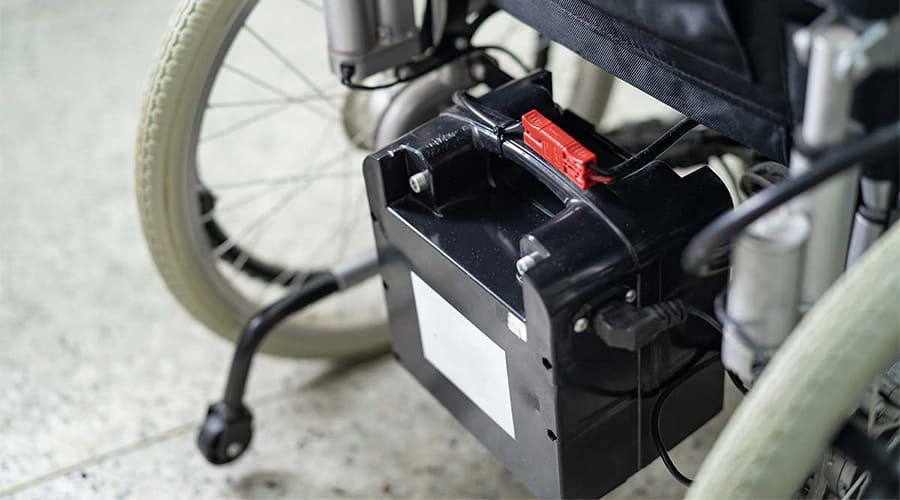
Electric Wheelchair Battery FAQs
What Types of Batteries Do Powerchairs Use?
In a word, powerchairs use Deep Cycle batteries, which can be discharged and recharged a number of times over the course of their useful lives.
Complicating things further is that there are two major types of Deep Cycle batteries: Sealed Flooded. Sealed batteries are so named because they cannot spill, while “wet” batteries must periodically have water added to the battery chamber. For this reason, “wet” batteries aren’t recommended for use in power chairs, though they are sometimes used.
I Just Got My Powerchair, Why is the Range Less Than Advertised?
Deep Cycle batteries have to be “broken in” in order to reach their full capacity and thus, provide the advertised range. This is completely normal. Your process should go something like this:
First, before you use your power chair for the first time, be sure you fully charge your batteries.
Second, during the first ten use and recharge cycles, be sure not to deplete your battery charge fully. In fact, for optimal results, don’t drain more than about a third of the charge of your onboard batteries before fully recharging.
After about ten cycles, your batteries will be fully broken in and will be primed for long, useful life.
After My Batteries Are Broken In, Should I Fully Discharge Them Before Recharging?
No. Fully discharging a Deep Cycle battery is never a good idea. Doing so will dramatically shorten the useful life of your batteries.
Okay, Then, How Often Should My Powerchair’s Batteries Be Charged?
Every day you use your wheelchair, at the end of the day, put your battery (or batteries) on the charger and charge them back up.
Fun Fact: If you discharge a Deep Cycle battery to 50% on any given day, then recharge it, your battery will have DOUBLE the lifespan compared to a battery that you discharge to 75-80% over the course of several days and then recharging.
What Will Happen If I Undercharge My Deep Cycle Batteries?
This question doesn’t get mentioned often in other battery FAQs we’ve seen, so we wanted to be sure to cover it here. The short answer is that undercharging your batteries isn’t a good idea.
Not only will it leave you with a reduced range (less than whatever the advertised range for the make and model you’re using), but it will also lead to more rapid deterioration of your batteries. It means that you’ll have to invest in replacements more often, increasing your total cost of ownership.
Can Deep Cycle Batteries Be Overcharged?
Typically not, but there’s one important caveat to that answer. It assumes that you’re using the charger that came with whatever make and model powerchair you’re using. In virtually all cases where that’s the case, the charger will monitor the charging status and automatically shut off when the battery is fully charged.
If you’re using a different charger than the one that came with your chair, all bets are off. It may or may not overcharge your battery, which could shorten the useful life of your batteries.
How Long Does It Take to Recharge a Powerchair’s Battery?
There’s no single, good answer for this. It depends on a number of factors, including how depleted the battery was when you hooked it up to the charger, the age of the battery, and its type. Our recommendation is that when you’ve finished using your chair for the day, hook the battery up to the charger and let it charge overnight.
As we mentioned in an answer above, if you’re using the charger that came with your power chair, it will automatically shut off when the charging is complete, and by the time you get up the next morning, it’ll be ready to go.
How Long Can I Leave My Electric Wheelchair Battery Plugged Into My Charger?
We covered this in a question above but wanted to spell it out explicitly here. There should be no problems if you’re using the charger that came with your power chair because, in the vast majority of cases, the charger will automatically shut itself off once the battery is recharged.
If you purchased some other wheelchair battery charger separately, then it may or may not have an auto-shutoff function, so you’ll want to monitor closely. As a rule, if you’re using a third-party charger, don’t leave the battery hooked up to it any longer than absolutely necessary.
I Bought a Third Party Battery Charger For My Chair, But It’s Not Working. Why Not?
It comes down to wiring patterns. If the patterns are identical between the charger your chair came with and the one you purchased separately, it should work fine. If there are differences, it won’t work at all.
Unless you have an engineering background, you may not be able to tell whether any given charger is compatible with what you’ve got, which is why third-party chargers aren’t generally recommended.
Can I Take My Batteries on an Airplane?
If you have a Deep Cycle battery labeled “Gel” or “AGM,” then in most cases, the answer to that is yes.
The vast majority of those are airline safe. In many cases, if the battery is airline-approved, you’ll find a sticker on it saying as much. Barring that, your user manual will almost always indicate whether or not the batteries in question are airline approved.
What Impact (If Any) Does Cold Weather Have on My Batteries?
Fun Fact: When powerchair manufacturers test the ranges of their products, they test at temperatures ranging from 75-80 degrees. If you’re operating your chair in that temperature range, you’ll see something close to optimal range results.
If you’re operating your chair in freezing temperatures, +/- 5 degrees, you will see a roughly 20% range reduction. Additionally, colder temperatures may increase your battery recharging time and shorten the life of your batteries. Whenever possible, recharge your batteries at room temperature.
I Have a 12 Volt Accessory – Can I Attach It to One of My Batteries?
Bad idea. Powerchairs are 24-volt systems, and the batteries are connected in series. If you drain one battery, the charger won’t equalize the charge in the batteries.
You’ll wind up with one dead battery and one that’s overcharged, which will degrade your batteries very quickly and ultimately render them useless.
I Purchased My Powerchair in the States, But I Want to Take It to Europe. Can I Do This?
Most of the powerchairs sold today have 220-240 volt battery chargers available, which makes taking your chair overseas a simple matter.
If your particular make and model doesn’t have such a charger available, then you could invest in a heavy-duty transformer from a third-party vendor that will allow you to use a standard (US) charger overseas as long as the wiring pattern is a match.
What’s the Typical Lifespan of a Deep Cycle Battery? What is Its Typical Shelf Life?
There’s no single answer to this question. If you use your chair intensively every day, you may only get a year or so out of your batteries before you need to replace them. If you’re a more casual user, you can probably coax two or three years of service out of them.
In addition to that, the daily power draw down matters. If you’re discharging your batteries to 50% each day, then recharging, they’ll last about twice as long as a battery that is used repeatedly over the course of several days, depleted to 80% or so, and then recharged. It is why daily recharging is recommended!
Also, note that as a general rule, gel batteries last longer than other types. You’ll pay a little more on the front end, but they pay you back in the form of improved longevity.
In terms of shelf life, most deep cycle batteries are good for six months sitting idle. Much beyond that, and they’ll begin to degrade.
Should you use one at that point, you’ll note a significant decline in range.
My Battery is Dead – Is There a Way I Can Coax a Little More Life Out of It?
Here, the answer is maybe. Sometimes. You certainly won’t lose anything by trying. Here’s what you do:
First, understand that in many cases, the reason the battery is dead is that it’s sulfated. This is especially likely if you’ve developed poor charging habits over the course of your ownership of your powerchair.
If that’s the case, then fully charging them and using them for five charge/full depletion cycles can sometimes remove enough of the sulfations that you can coax a bit more life out of it.
There are a few things to bear in mind here, however:
First, it may not work. Second, the charging time may be substantially longer than you’re accustomed to, and third, even if it works, know that your batteries are on their last legs, and you should immediately begin shopping for replacements.
Are All Deep Cycle Batteries Pretty Much the Same, or Are There Quality Differences?
As with most anything, there are quality differences from one brand to the next. In the world of batteries, the more expensive ones typically have thicker plating and benefit from better overall manufacturing quality control, which combines to give you better performance and longer useful life.
It’s definitely a case here of “you get what you pay for.” If you buy a bargain-basement battery, you can expect that it won’t last as long as a higher quality, more expensive option.
Where Can I Buy Replacement Batteries For My Chair?
Just about every powerchair manufacturer sells replacement batteries for their products, and your best bet is to stick with the batteries the manufacturer offers for their chairs.
If that’s not an option, you can find a viable replacement battery for your chair at any retailer that specializes in batteries. If you do so, you’ll want to be sure that it’s safe to use the battery you get with your powerchair.
Most of these will be sold as “RV” or “Marine” batteries, so it may not be immediately obvious, but any knowledgeable battery vendor will be able to guide you appropriately. The key factors are that the replacement battery be:
- Sealed
- Deep-Cycle
- Of the proper Group size
- And having physical dimensions that align with the mounting space on your chair and have compatible battery terminals
Other Battery Dos and Don’ts
While the questions above cover quite a lot of ground, they don’t answer everything. With that in mind, here are a few additional tips, presented in no particular order:
- If you only use your chair occasionally, you may be well served by disconnecting the batteries. A good benchmark here is two weeks.
- You should put a reminder in your phone or on your calendar to check your battery terminals every month or so for signs of corrosion.
- Any time you’re disconnecting the charger, be sure you grip the connector and pull from there, rather than pulling on the cable itself.
- Avoid using extension cables to recharge your batteries unless they come from the manufacturer who sold you the chair you’re currently using!
Final Thoughts: Electric Wheelchair Battery FAQs
Although it’s not immediately obvious, there are actually a lot of things to consider where your powerchair’s batteries are concerned, and the battery FAQs above are reflective of that.
Our hope is that this article answered all questions you might have about the batteries for your powerchair. If you have a question we didn’t cover here, and you can’t seem to get a straight answer, just leave us a note in the comments section. We’ll do our best to answer your question, adding both the question and its answer to our guide!