
If you’re glancing over your sports wheelchair order form, you might notice an assortment of casters that come in different shapes and sizes.
Understandably, it can be overwhelming to navigate the choices. Whether you’re a full-time athlete or want a sporty everyday use caster, each type offers a unique experience that aligns with various lifestyles.
In our guide, we go over sports wheelchair casters in detail, so you can feel confident in your selection.
What to Consider When Choosing Wheelchair Caster Wheels
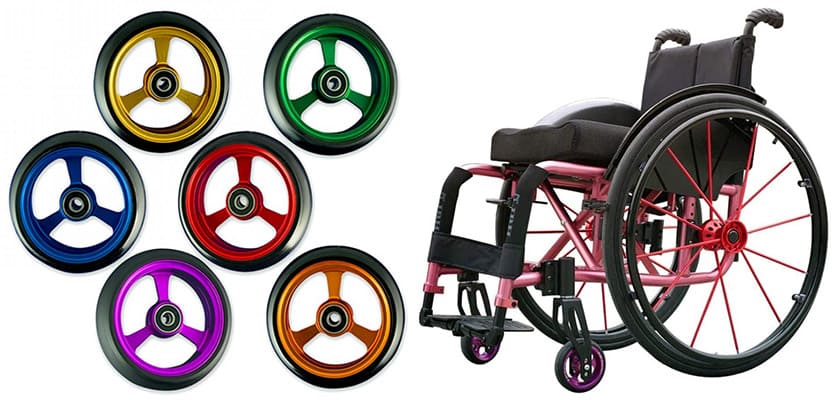
Before delving into the world of caster sizes, be clear about what you want to do with your wheelchair.
What types of activities will you partake in on a regular basis, and how often will you be indoors or outdoors?
These questions are important, because as mentioned- not all casters are created equal.
For example, there are pneumatic wheels that are filled with air and foam-filled wheels that are solid and can’t be punctured.
If you spend most of your time indoors, you’ll probably want the pneumatic variety for a smoother ride in a low-risk environment.
On the other hand, foam-filled tires are better suited for use on rough terrains, such as for people who work in construction.
Another important factor is sports wheelchair alignment. Depending on the type of activities you enjoy, you’ll want to make sure the positioning enhances performance while staying safe.
Now, without further ado, let’s look at the different sizes and types of casters.
Best for Sports: 3” Roller Blade Casters
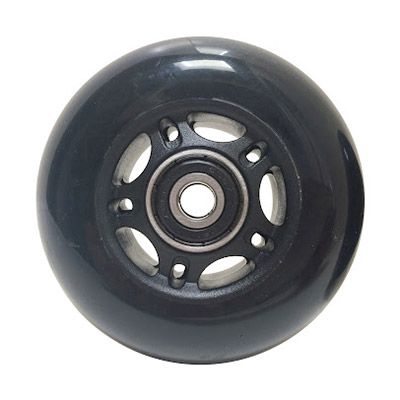
These wheelchair front casters are small, hard, and rigid, making them highly efficient on smooth surfaces such as basketball courts, tennis courts, and rugby courts.
The 3” size fits a compact wheelchair frame seamlessly, which gives the user more control and the best handling for intense sports activity.
However, 3” casters aren’t recommended for everyday use around the house or to run errands in town. They create rolling resistance when in contact with any surface other than smooth, hard surfaces.
That means if you try to push these casters over carpet, pavement, snow, or gravel- you’ll be huffing and puffing in no time.
You might’ve glimpsed wheelchair advertisements that show off a sleek sports wheelchair with small casters perched on the beach or in the snow. This is just for hype and not realistic- don’t fall for it!
Best for Everyday Use & Sports: 4” Micro Aluminum Casters
You might not be a serious athlete, and that’s OK- there is a caster for you!
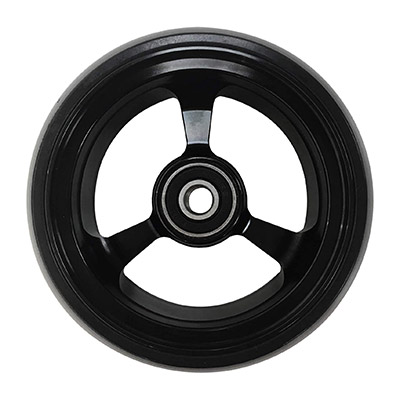
If you play sports infrequently or want a wheelchair that performs well at home and on the court, then 4-inch wheelchair casters are your best friend.
This type features an aluminum rim and a solid, urethane tread. These casters are stylish, with a low profile that also fits on a compact wheelchair frame.
The biggest benefit of this type of caster is that you don’t have to go for a sports wheelchair and another chair for home use. This gives you the best of both worlds.
Best for All-Purpose Use: 5” Poly Casters
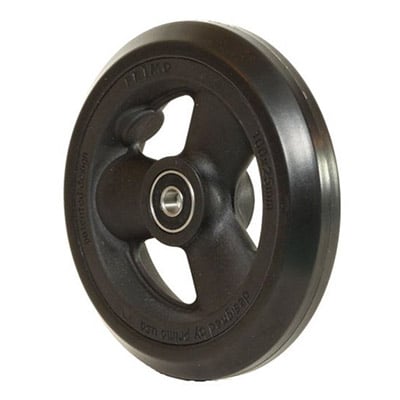
For something with more girth, traditional 5-inch wheelchair casters boast a 1” width, while recent units are designed with a 5×1 ½” width. It features a plastic rim and a solid urethane tread.
Although these are bigger wheels, they are still lightweight and compact, with lower rolling friction outdoors compared to the casters we covered above.
This type is the most popular amongst sports wheelchair users, providing easier handling on smooth, hard surfaces with added support when rolling over carpet, dirt, snow, grass, and gravel.
This makes the 5” a superb all-purpose caster, but bear in mind that it can also be expensive, especially if you opt for aluminum rims instead of plastic.
Nonetheless, the performance is reliable if you’re frequently outdoors, with the same comfort for indoor use.
Best for Outdoor Use: 6” Poly and Pneumatic Casters
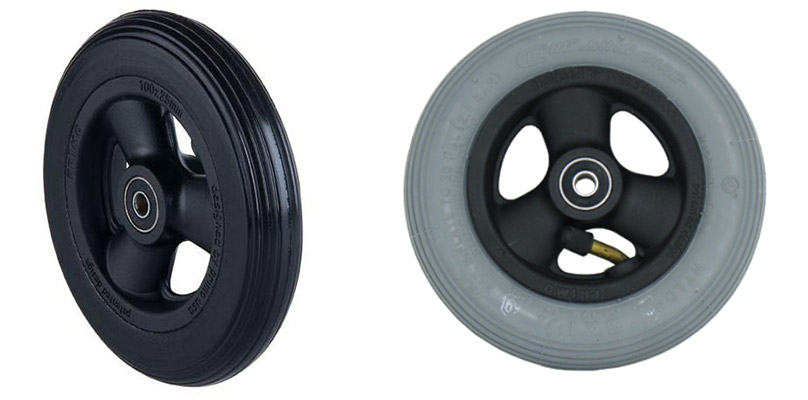
The rule of thumb regarding wheelchair tires is the larger the wheel, the better suited it is for rugged terrain. That’s what makes the 6-inch caster the best choice for the outdoors.
These casters are typically pneumatic, which is the best type for absorbing shock when rolling over bumps. That gives sports wheelchairs with a 6” caster system a smooth, cushioned ride that ensures comfort, but it does come at a price.
Pneumatic tire pressure needs to be maintained to prevent punctures, so count on topping off the air once a month.
Pro Tip: If you have 5” casters with a valve stem opening on the rim, but you want 6” casters, save yourself some moola and simply replace the 5” tires with a 6” tire and tube. It should work just fine on the existing rim without having to invest in a whole new set of wheels.
Old School: 7”- 8” Casters
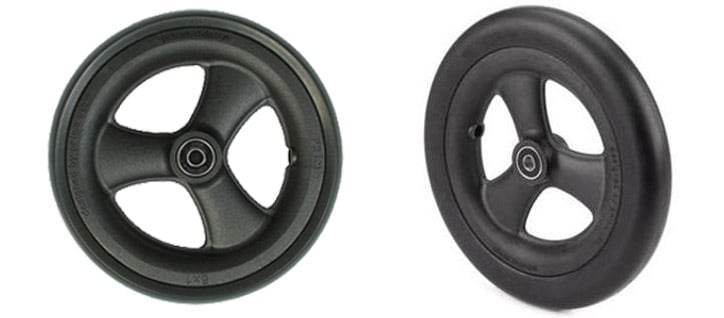
This isn’t a caster you often see nowadays, but back in the 1980s, 7” to 8” wheels were the common choice for sports wheelchairs.
Since then, wheelchair designs have become sleeker and lighter, doing away with bulky casters that require a large berth of clearance to pivot with ease.
And while larger casters are preferred for the outdoors, this size makes it complicated to maneuver indoors, especially in tight spaces.
If you want to go big, stick with 6” casters, and you’ll be able to roll inside or outside with less frustration.
3 Accessories That Enhance Caster Performance
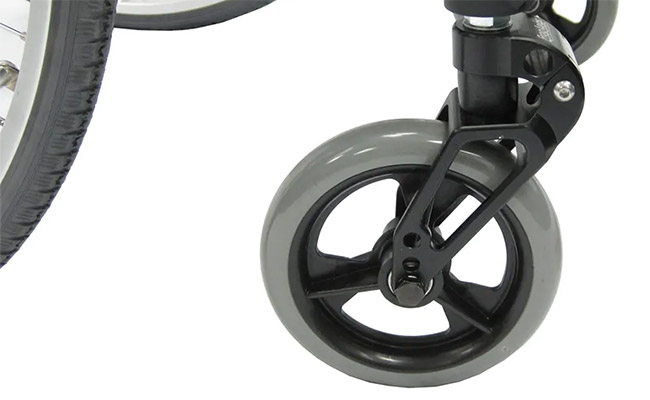
Choosing front caster wheels for wheelchairs is one thing, but if you’re on a budget and looking to enhance the performance of your current system, there are a few handy accessories that can improve how you roll.
- Frog legs casters: Also referred to as soft roll casters for a wheelchair, this improves suspension to make your ride smoother for comfort, instead of getting jolted whenever you hit a bump on the ground.
- Light-up casters: If you go out at night, these casters light your path and enhance safety by allowing pedestrians and drivers to see you clearly.
- Wheelchair socks/slippers: Rolling outside means your wheels will probably get dirty. These easy covers prevent dirt, mud, and other undesirables from getting tracked inside your home after a jaunt outdoors.
Final Thoughts on Sports Wheelchair Casters
Sports wheelchair casters come in a few different sizes and materials, and each type offers unique benefits that correspond with various lifestyles.
If you’re a serious athlete, the smaller the caster, the more speed and maneuverability you’ll have– as long as you stay on a smooth, hard surface.
On the other hand, if you do outdoor activities but also want to use your chair indoors without issue, go for a larger caster pneumatic caster that provides sufficient shock absorption while still being able to pivot on a dime.
Resources & References: