
How well does the controller that came with your power wheelchair work for you? Is it as comfortable as you’d like? Can you use it easily and without struggle? Is it comfortable and convenient to use?
If you didn’t answer yes to all of those questions, then this article is for you! The simple truth is that there are more types of controllers for power wheelchairs than you might think. In this piece, we’ll outline the various options available to you.
How Many Different Types of Electric Wheelchair Controllers Are There?
The question posed by the heading above normally only comes up after someone discovers the wide world of controller options and wants to know more. Let’s break it down:
So, broadly speaking, controllers come in two basic types – Integral controllers and Modular controllers.
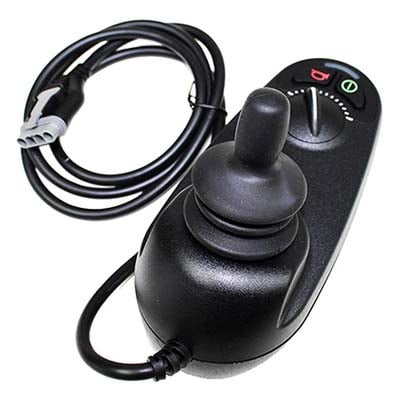
Integral controllers are all-in-one devices. Everything you need to control the movement of your chair is built onto the controller itself. It is overwhelmingly likely that the power wheelchair you purchased came with an integral controller that took the form of a standard joystick controller.
Contrast that with a modular controller, which has separate components that manage the various functions of the wheelchair. Both types of controllers will likely incorporate a joystick, but other types of user interface devices can be used as well.
If you want to stick with a basic joystick controller, you’ve got a surprising number of options to choose from.
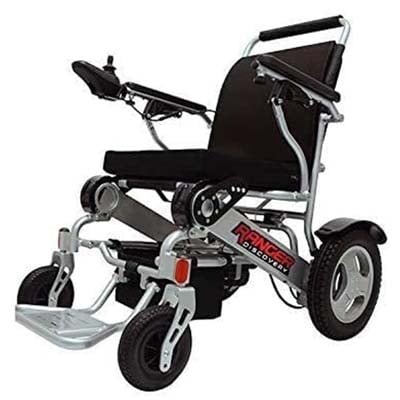
Most of the electric wheelchair joystick controllers that come standard with chairs are simple “post-style” controllers. Still, if you like, you can easily swap that out with a goalpost control stick (shaped like a football goal post), a “T-handle” post, or even swap the post out entirely for a trackball style controller. They even make miniature varieties of all of the above if the standard controller is too big for your hand.
Whatever form they take, most joysticks are proportional controllers, which is to say that not only does the chair move in the same direction you move the joystick. Also, the farther you move the joystick in a given direction, the faster you’ll go in that direction, up to the limits of the top speed of your chair, of course.
Although there are a variety of options, wheelchair joystick controllers don’t represent the end of the road in terms of possibilities. You can find a wide range of alternatives to the joystick-based controller, including:
You’ve got a lot of flexibility where this type of control system is concerned. You can have it programmed so that touching a certain section of the pad will perform a specific function or simply have it set up to respond to the direction that you drag your finger across the pad.
You can find a whole range of switch controls (and a lot of other cool stuff) here.
In addition to these, a small number of high-tech devices are designed to read and respond to eye movements. Here, you can change the direction of your chair via simple eye movements and control your speed via blinking. This type of technology is generally paired with a tablet PC mounted at eye level to the front of the wheelchair you’re using. Here are a few examples:
Other Considerations
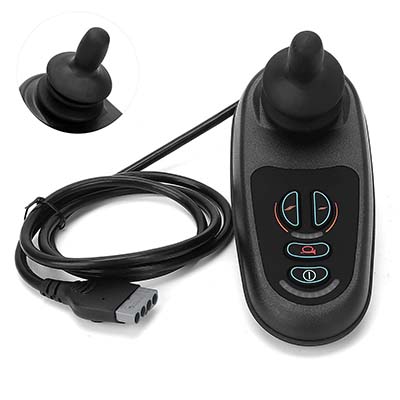
It’s not just the type of control system that matters; its location and specifications are important too.
Fortunately, most electric wheelchairs on the market today make it easy to move the control system from one side of the chair to the other. In fact, many models allow you to specify which side you want the default control system on when you place your order.
In addition to that, almost all of the control systems on the market today can be programmed and customized so you can vary the amount of force needed to actually move the chair via the controller, increasing or decreasing its sensitivity to suit your tastes and needs.
This brings us to the notion of “Profiled” vs. “Non-Profiled” Controllers.
When talking about the controllers that come standard on most power chairs, most of them are non-profiled, but it’s entirely possible to find a few that are profiled.
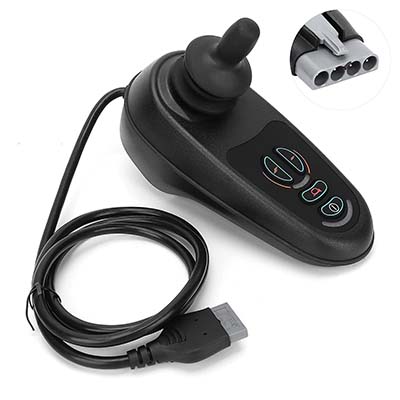
The difference is that in a Profiled Control System, every element of the chair’s performance, from speed to acceleration and deceleration to turning radius and speed, can be programmed depending on exactly how you’re using the chair and what type of terrain you’re using it on.
In short, Profiled Controllers offer you maximum flexibility, while Non-Profiled Controllers tend to be “one size fits all” solutions.
Ultimately, which type of controller is best for you depends on you as the chair owner. If you want fine-grained control and the ability to customize your ride based on what you’ll be doing on any given day, then a Profiled Controller is the way to go. If you don’t want to be bothered with all that, then stick to a Non-Profiled Controller.
What Type of Power Wheelchair Controller is Best For Me?
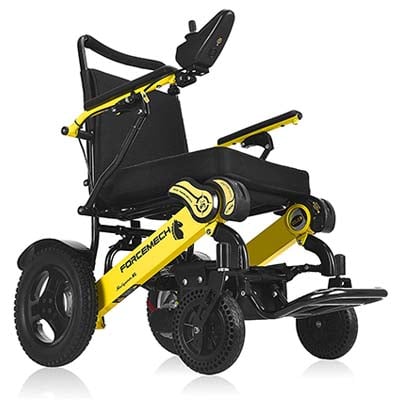
Since there are so many types and flavors of power wheelchair controllers on the market today, there’s really no “right” answer to this question. If you’re unhappy with the default controller that came with the chair you’re using, the first step to finding a replacement is to sit down and ask yourself exactly what it is that you don’t like about the existing controller.
Is it too big for your hand (or too small)? Are you able to use it comfortably? Are you able to use it at all? Does it offer the kind of fine-grained control you’re looking for?
Once you’ve identified the specific shortcomings of your current control system, it’s a lot easier to gravitate to a class of wheelchair controllers that would serve you better. Once you find the system that’s the best fit for you, your capabilities, and how you plan to use the chair, it’s just a matter of finding someone to install the controller you’ve selected onto your current chair.
Note that in many cases, the vendor of the control system can do that, but if not, they can almost certainly make recommendations of someone who can.
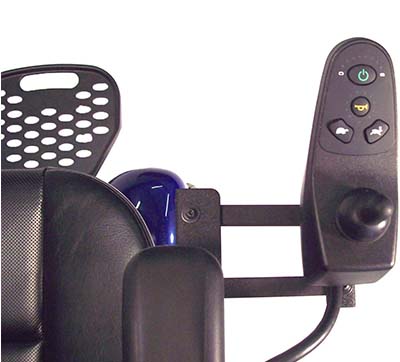
Finally, depending on how deep into the weeds you want to go where your chair’s control system is concerned, you may want to pay close attention to its amperage rating and fold back.
In the world of wheelchairs, amperage can be considered the equivalent of horsepower in the auto world. If you want maximum performance, then more is better.
Fold back can either be time or heat-related and has to do with a chair that has been running at maximum amperage long enough to trigger an auto-shutdown. The fold back is the time or temperature threshold you’ll need to reach before the chair can be safely restarted.
Do you need to be an expert on amperage and fold back to get value from your chair? Absolutely not, but again, if you want to, you can dive down that rabbit hole and squeeze a bit more performance out of whatever chair you’re using.
Final Thoughts on Electric Wheelchair Controllers
You don’t have to just live with the controllers that your current wheelchair came with.
If it’s not what you need, there are tons of great options on the market today, and you can find an alternate control system that will serve you better.