
When Was the Wheelchair Invented
If you’re like us, not only are you intrigued by wheelchairs but you’re also intrigued by the history of wheelchairs, especially the parts that no one else knows.
4000 B.C. – The chair and wheel exist in the eastern Mediterranean basin
Nevertheless, that’s a little too far back for our discussion, so let’s fast forward billions of years to, well, let’s say, 4000 B.C., to the eastern Mediterranean basin, where they didn’t yet have supermodels sunning themselves; however, what the Mediterranean basin did have were the inventions of the wheel and the chair. Sure, you say, this must be where the wheelchair was born. After all, it doesn’t take a genius to add wheels to a chair, to create a wheelchair. But, remember, these folks didn’t have 300 television channels or fruit roll-ups, so they were a bit behind the times, at least by a few thousand years, or so.
530 B.C. – Greeks place wheels on a bed

But, in 530 B.C., the Greeks placed wheels on a bed, creating the first combination of wheeled furniture. (We know this from scribbling on an old pop bottle — or illustrations on an ancient Greek vase, as the literati would say.). Ornaments from the same period, depicting the Departure of Triptolemus, show him riding a chariot with a significant resemblance to today’s wheelchairs.
If the device actually existed, it seems clear it was a one of a kind creation, and it may or may not have been intentionally built to serve as a mobility device.
200 A.D. – Chinese create rolling apparatus for the infirmed
By the Third Century, the Chinese were savvy enough to create a wheelbarrow-type apparatus to cart the infirmed – or, as the young kids say, physically challenged.
525 A.D. – Chinese place wheels on a chair
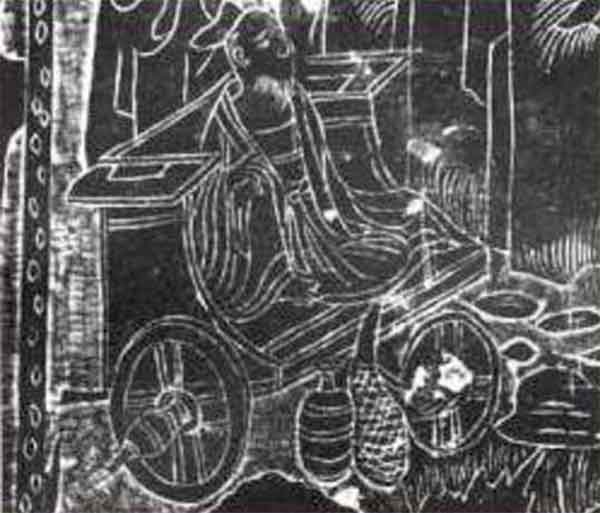
While the Greeks were lounging on their wheeled beds and eating grapes (and Charleston Heston began his film career), the Chinese placed wheels on a chair in 525 A.D..
1553 – Greeks and Romans create wheeled mobility for disabled
But, the Greeks and Romans were hardcore toward disability rights, and in 1553 created wheeled mobility to get the disabled to the work fields.
1595 – King Philip II creates wheeled chair with footrests
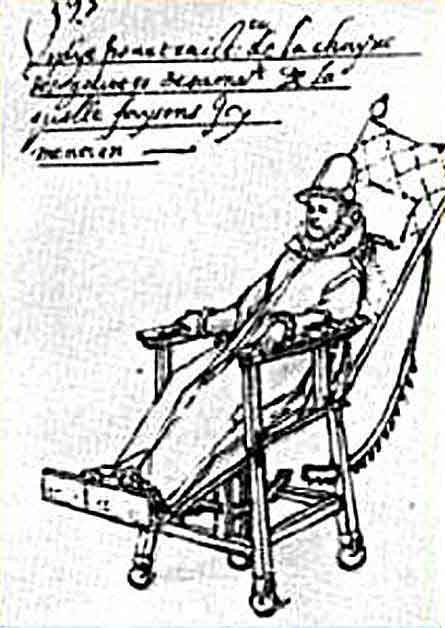
While the Greeks and Romans were dedicated to drinking wine and watching those with disabilities work in the fields, the Spaniards were just happy drinking wine. So, in 1595, King Philip II created the first wheeled chair with backrest and footrest, so he could hold his chalice of wine, while wheeled by servants (hopefully reflective of our retirement years). It was more like today’s transport chairs.
1655 – Farffler builds self-propelled wheelchair
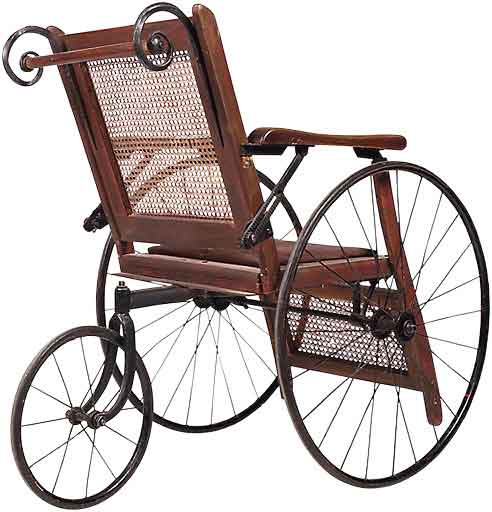
Meanwhile, someone said to Stephan Farffler, a watchmaker, “Stevo, do you know what time it is? It’s time for you to build yourself a wheelchair, for you can’t walk.” And, in 1655, Farffler, a 22-year-old paraplegic, built among the first self-propelled wheelchairs. As cool as the invention was, it too was a one of a kind creation and not something that was built for the masses.
1783 – Dawson produces commercial wheelchair
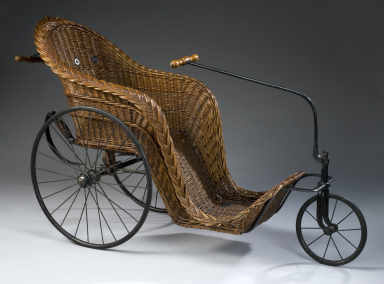
An Englishman from Bath, John Dawson, built the first commercial wheelchair in 1783. Now, when we say “commercial wheelchair,” we don’t mean those rented by Wal-Mart to show on thirty-second television ads that they are disability-friendly. Rather, what we mean is, Dawson refined the wheelchair as a universal product, complete with adjustable legrests and reclining backrest. Dawson’s interpretation of the wheelchair as a device of practical mobility set the pace for the modern wheelchair.
It had two large wheels, like modern wheelchairs. It could be self-propelled, pushed, or pulled by a horse or donkey, making it incredibly versatile. It was an expensive piece of equipment, but it was more widely available and could be purchased by anyone of means.
Who Invented the Wheelchair?
If you’re looking for the name of the man who invented the wheelchair as we understand it today, that honor has to go to John Dawson. It still looked significantly different than the wheelchairs of today, but all subsequent wheelchair designs can be traced back to this one.
Ultimately, “who invented the wheelchair” depends on exactly what kind of wheelchair you’re talking about, but in terms of the most basic, relatively widely available design, we’d award the title to John Dawson and his Bath Wheelchair.
1869 – Less bulky
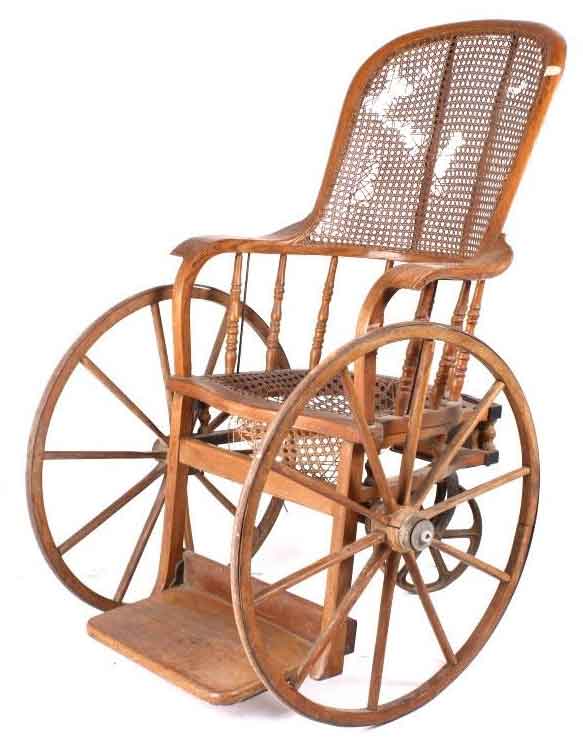
The next big improvement came in 1869 when a self-propelled wheelchair was patented that featured large rear wheels and was significantly less bulky than the Bath design. Less bulky or not, the 1869 model was still not easily transportable.
1881 – Pushrims added
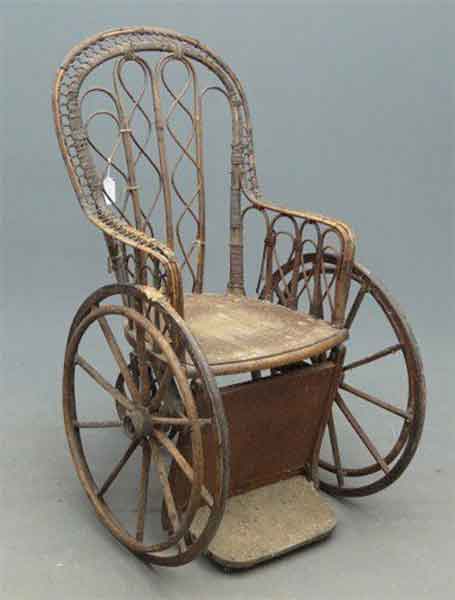
While Dawson’s chair was a leap in technology, it wasn’t winning races at Boston, so others saw great room for improvement. In 1881, pushrims became standard fair.
1900 – Wire-spoked wheels
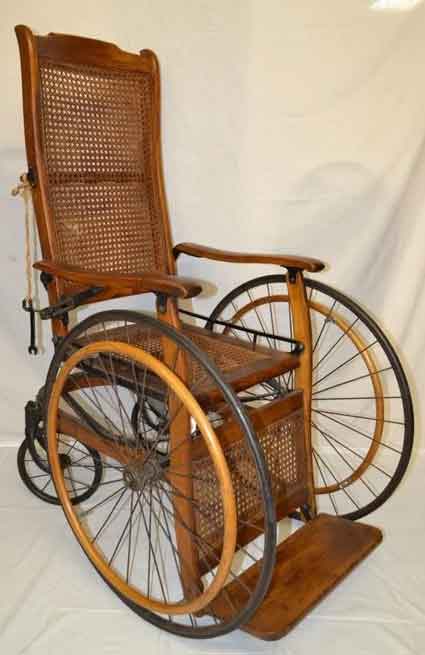
In 1900 wire-wheels replaced wooden wheels.
1912 – The Invalid Tricycle
A small combustion engine was added to a 3-wheeled wheelchair called the “Invalid Tricycle”. The idea soon proved to be… well, “invalid”, and ended up having “no traction”.
1916 – First Power Chair available
In 1916, the first power chair rolled around London. But the idea was too costly to be adopted.
1933 – Everest and Jennings create modern folding wheelchair
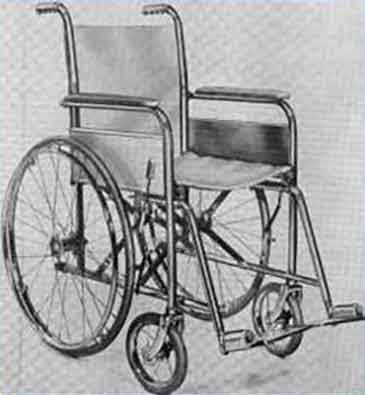
In 1933, with little more than a garage and a disability, Herbert Everest propositioned his friend, Harry Jennings, to start a band – or, so we like to suppose. However, because garage rock wouldn’t take off for 57 more years, and they were both engineers, Everest and Jennings opted instead to improve the wheelchair, creating a folding X-frame that increased transportability, the design that remains the industry standard today.
Together, they formed the Everest and Jennings company, which had a virtual monopoly on the wheelchair industry for the next several decades.
If you could find a Jennings chair today, it would certainly look like an antique, but it really wouldn’t be all that different from the modern designs on the market today, and that’s pretty cool.
1950 – Who Invented The Electric Wheelchair?
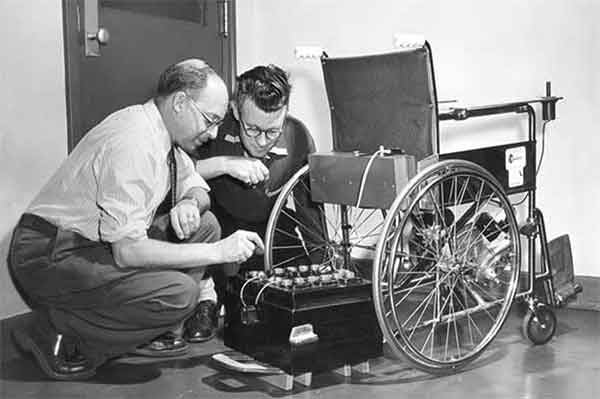
Although around 1913 George Westinghouse produced some drawings for an electric wheelchair, and a first design was seen in London in 1916, the invention of the electric wheelchair is attributed to a man named George Klein. His goal was to assist veterans returning home from the Second World War.
The first electric wheelchair was large, heavy, and ungainly, and since its initial invention, the size and weight have come down considerably. There has been an explosion of different styles, but they can all trace their origins back to the Klein chair.
1963 – Uddén refines modern powerchair
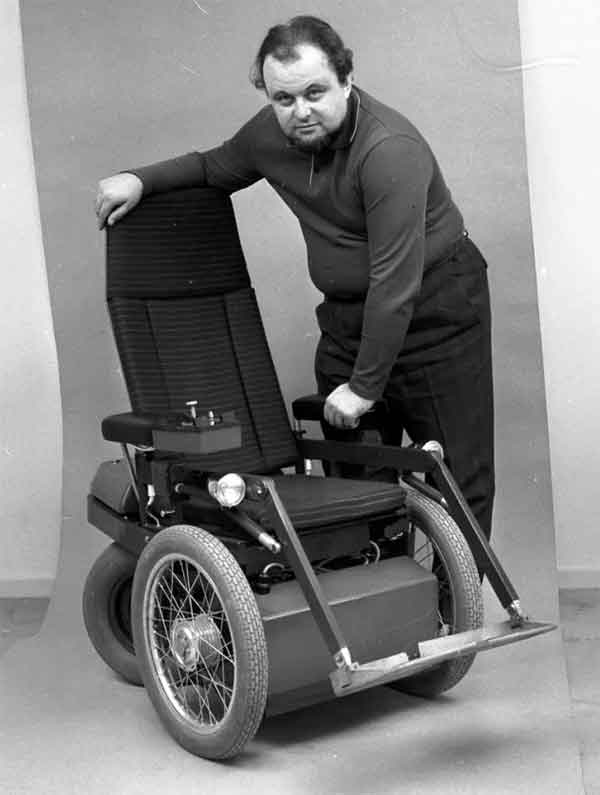
Whereas E&J revolutionized the manual wheelchair in 1933, Swedish doctor, Per Uddén revolutionized the powerchair in 1963, with the chair coined Permobil.
1962 – Who Invented The Wheelchair With A Ventilator?
This is an interesting one, and the design dates back to 1962, and a man named Robin Cavendish, who was affected by polio, which paralyzed him from the neck down. Suffering from deep depression as a result of the illness and only able to breathe with the help of a ventilator, friends noted a marked improvement in his mood when they were able to get him outside for at least a while, which is how and why this unusual type of chair came to be.
If you’ve heard friends talking or maybe vaguely remember a movie about the guy who invented the mechanical wheelchair and had a muscular disease, the movie you’re thinking about is called “Breathe,” and yes, it’s about Robin Cavendish!
1966 – Who Invented The Wheelchair Lift?
Unlike many of the other inventions we’ve been talking about, which are quite recent innovations, the wheelchair lift has been with us since 1966, when a man named Ralph Braun built the first prototype. His invention launched an entirely new industry and really expanded the possibilities for people who use wheelchairs. Braun made it possible for people with mobility issues to fully engage with the world by making travel and adventure a much easier proposition.
1973 – Who Invented The Wheelchair Ramp?
Technically, no one did. Ramps have been used for thousands of years, both as people and material movers. Ramps were even used to create the great pyramids!
The closest we can come to naming a singular individual responsible for building the first ramps designed specifically with wheelchairs in mind would be George Klein, who we’ve mentioned before (he was also the father of the electric wheelchair).
Honestly, though, it was the 1973 Rehabilitation Act that paved the way for the widespread use of wheelchair ramps in public buildings, so although ramps are an ancient technology, that act and George Klein do deserve a tremendous amount of credit.
Without both, people who have mobility issues would no doubt have a much more difficult time getting around!
1976 – Lightweight manual wheelchairs
By the mid-1970s, Errol Markheim at Sopur in Germany, Jeff Minnebraker at Quadra in California, and Rainier Kuschall in Europe, all latched on to the next evolution of manual chairs, creating lightweight, aluminum, highly-adjustable chairs (aluminum worked well for airplanes and beer cans, so why not wheelchairs?).
Beyond the 1970s
Have there been evolutions in wheelchairs since 1976? Sure. We can point to the powerbase powerchairs in the 1980s, manual wheelchair suspensions in the 1990s, mid-wheel powerchairs with suspension of the late 1990s, and 6-wheel powerchairs in the 21st century, but we won’t mention those.
1997 – Who Invented The Beach Wheelchair?
The beach wheelchair was invented in 1997 by Michael Demming for his wife Karen, who suffered a terrible accident that left her a quadriplegic. Wanting to give his wife the freedom to move about outdoors, he designed and built a prototype “all-terrain wheelchair,” which not only created the world’s first beach wheelchair but spawned an entire industry.
2001 – Who Invented The Stair Climbing Wheelchair?
Dean Kamen, the creator of the Segway, also invented the iBot, which was the world’s first stair-climbing wheelchair, initially unveiled in 2001. The chair was briefly marketed but discontinued as being simply too expensive.
The good news is that after nearly two decades of gathering dust, Toyota has decided to take another crack at the design to try and develop something that’s both effective at navigating stairs and more affordable.
2002 – Who Invented The Mind-Controlled Wheelchair?

You may not even be aware that such a thing exists, but this is an actual “thing” that dates back to at least 2002. It was invented by Diwakar Vaish and a fully functioning prototype built in 2009 when a mind-machine interface was successfully paired with a mobility device allowing the chair to be controlled by nothing but the brainwaves of the person sitting in it.
Without going into too much technical detail, the person sitting in the chair wears an EEG on his or her head, which reads the electrical impulses of the brain and sends them to a controller board that interprets them and activates directional motors on the chair, allowing movement in any direction.