
Few people use their wheelchair in its stock configuration, or at least, they don’t do that for very long.
That makes sense. There are dozens of cool aftermarket enhancements you can buy to help you customize your ride in ways that make it more useful to you. Who wouldn’t want that?
Here’s the thing, though:
Every little bit and bob you add to your chair inevitably adds weight. To a point, that may not be a problem, but you may find that you’ve crossed a threshold sooner or later. One fine day, you wake up and realize that your once fairly lightweight chair has gotten inconveniently heavy. It has put on so much weight that it’s just not as useful as it once was.
Or maybe you’re coming from a different direction. Maybe, you got a chair, and at first, you really liked it. Over time, though, you began to realize that the weight was an issue and the chair wasn’t all that easy to travel with.
Either way, the day may come when you find yourself wanting or needing to put your trusty wheelchair on a diet and help it shed a few pounds.
If that’s where you are in the here and now, this article on how to make your manual wheelchair lighter can help. Below, we’ll talk about a number of things you can do to make the chair you rely on lighter and more travel-friendly. Let’s jump right in and take a closer look!
Note: When we discuss weight-trimming strategies in this piece, please understand that we’re estimating the weights here. Every manufacturer uses different components, and the weight of various pieces and parts of your chair may vary slightly from what we talk about here. That is expected!
How Wheelchair Weight is Determined
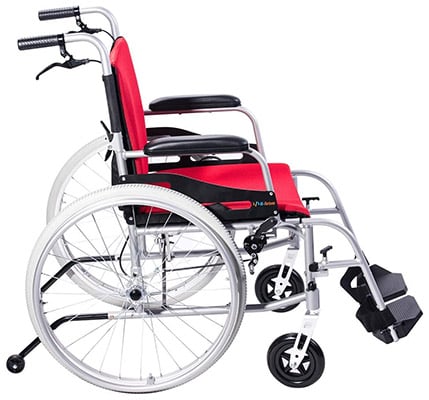
Before we talk about lightening the load in detail, we should say a few words about how manufacturers arrive at the weight of the product they’re selling.
It matters because one of the values prospective buyers look at when evaluating models for purchase is weight. Most manufacturers prominently list this value because they know it’s a major consideration for a lot of people.
You might think that companies would simply roll the chair onto scales and record the number, but it’s not quite that simple.
In order to make their product more attractive to people who are looking for a lightweight option, they’ll weigh the chair in its most bare-bones, stripped-down configuration.
Sure, some people use their wheelchairs like that, but most don’t. Right off the bat, your wheelchair probably weighs at least a few pounds more than you think it does.
With that out of the way, let’s start breaking down a typical manual wheelchair to see how much the different components weigh.
Rear Wheels
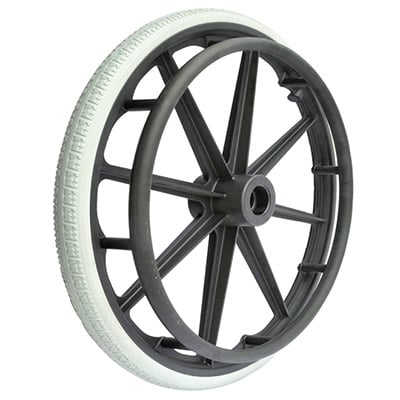
Did you know that in many cases, the rear wheels of a manual wheelchair will make up nearly 50% of the total weight of the chair? Given that, if your goal is to keep the total weight of the chair to an absolute minimum, keeping the weight of the wheels down should be a very big priority.
So how much do wheels weigh?
Well, let’s look at the example of a 24” spoked wheel with an aluminum hand rim (without the tire) that weighs about 3.5 pounds. For two of those, you’re looking at about seven pounds total. Mag wheels look great but will add about two additional pounds to the total.
If you want to go the other direction, the company you want to take a close look at is Spinergy. Their “Spox” wheels are expensive, but they are incredibly well made and about a pound lighter than the stock wheels you’ll find on most manual wheelchairs.
Rear Tires
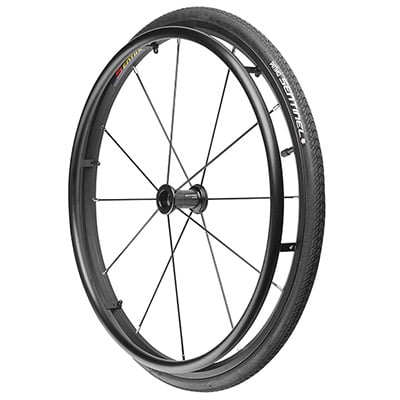
Bear in mind that when we talked about wheels above, we were only talking about the rims and not the tires. As with your rims, tires can add more weight than you might think to a manual wheelchair.
You can find a 24” in diameter rear tire that weighs about 1 pound each (so two pounds for the set).
If you have flat-free tires, that will add about 3.5 pounds to the chair (about 1.75 pounds per tire). If the tires you add to the chair are pure polyurethane, that will add about 2 pounds beyond that (total).
Casters
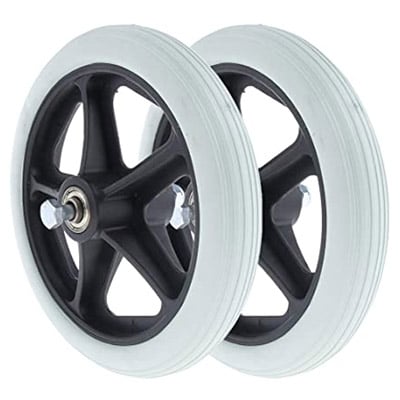
Casters come in all shapes and sizes. You can find them as small as 4” in diameter, large as 6” – 8” or even slightly larger, with the exact number of casters varying depending on the make and model of the chair you’re using.
The good news is that casters are easy to swap out, and if you can live with a smaller size, you’ll incrementally lighten the weight of your chair.
Caster weight varies depending on exactly what they’re made of. As a general rule, a pair of 4” casters weighs about a quarter of a pound (0.25), while a pair of 5” casters weighs about half a pound (0.5), and a pair of 6” casters weighs about three-quarters of a pound (0.75).
The tradeoff here is that smaller casters are less able to move over rough terrain or even plush carpet, so you’ll want to think carefully about how and where you use your chair before swapping to a smaller caster.
On the flip side, if you judge your current casters to be too small and your chair is performing poorly as a consequence, it’s easy enough to add larger casters. Just be aware that you’ll see a nominal increase in the chair’s total weight.
Seat Cushions
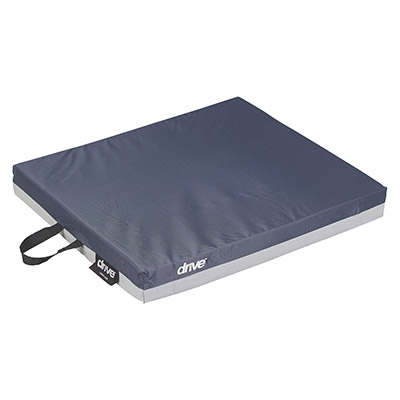
Most of the chairs sold today don’t offer a lot in the way of padding. Most people want to sit comfortably, though, which makes seat cushions among the most common wheelchair modifications on the market today.
The exact weight of your seat cushion varies widely, with simple foam cushions tending to weigh the least and gel cushions tending to weigh the most.
On average, seat cushions will add about five pounds of extra weight, so think carefully before you take your cushion with you when traveling with your chair. If you can get by without it, it’s a quick and easy way to reduce the weight of whatever chair you’re using.
Armrests
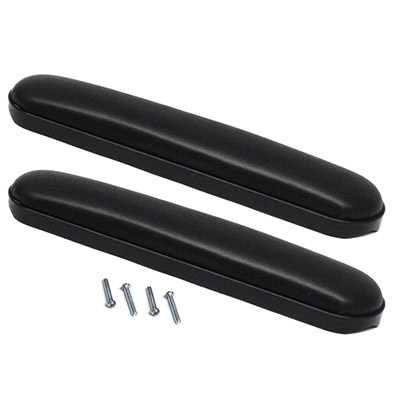
Unless you’ve purchased a highly custom modified wheelchair, the odds are that you won’t be able to do much with your armrests other than take them off or put them on. Some companies sell alternate armrests, and the companies that do may allow you to hot-swap them for armrests of a different configuration.
Height adjustable, full-length armrests weigh about six pounds (for the pair). Desk-length arms weigh about five. If you’re going somewhere and you don’t think you’ll need the support that armrests provide, removing them is a quick and easy way to lighten the load, though be aware that your ability to do so is highly dependent on what make and model of chair you’re using.
Other Accessories
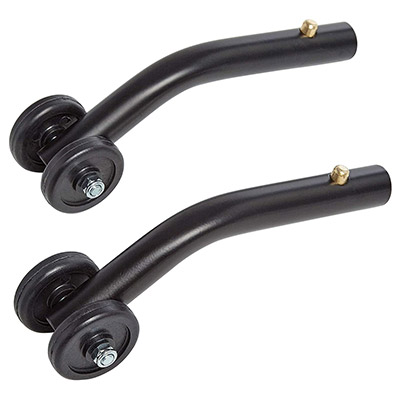
You can buy all sorts of accessories and you can make wheelchair modifications that will add value to your chair. Unfortunately, every single one of them will also add to the weight.
In some cases, the extra weight is trivial. After all, a cup holder adds almost nothing. In other cases, though, adding something like a cane holder or a holder for an oxygen tank may wind up adding a couple of pounds, and that can add up quickly if you start putting several of them in place.
Here are a few other examples:
- Anti-Tippers – about 1.5 pounds
- Aluminum side guards – about 2 pounds
- Spoke guards – about 1.5 pounds
- Tension-adjustable backrest upholstery – about 1 pound
Final Thoughts on How to Make Your Manual Wheelchair Lighter
All told then, you can do all sorts of things to make your wheelchair lighter, and sometimes, every pound really matters.
Our recommendation on how to make your manual wheelchair lighter is to treat your chair as a highly modular form of transport. If you’re going somewhere, spend some time thinking about which components you really need and which ones you could live without for that particular trip. Then, take off the bits you don’t think you’ll need.
Using the numbers above, if you traded out your 6” casters for 4,” got the lightest wheels you could, removed your armrests, left your cushions at home, etc., you could easily shave ten pounds from the total weight of your chair.
The downside is that if you wind up needing one of the elements you took off, you’re simply out of luck. Plan the matter carefully because it is a tradeoff. Sometimes, you need the functionality, and the weight it adds isn’t a big deal. Other times, the weight really matters, and every pound you can shed is a very big deal.
Resources & References: