
Are you happy with your current power chair? Whether you are or not probably depends largely on how happy you are with the chair’s overall maneuverability, and that is, in large part, determined by your chair’s pivot point.
You may not realize it, but the pivot point of your chair is hugely important. Not only does it ultimately determine how maneuverable your chair is overall, but the pivot point, intersecting with how and where you use the chair, plays a quiet, underlying role in determining how satisfied you are with your current ride. In this article, we’ll explain why. Curious to know more? Read on!
Drive Wheel Options, Explained
You’ve got three drive wheel options in the world of power chairs: Front-Wheel Drive, Rear-Wheel Drive, and Center-Wheel Drive (also often called Mid-Wheel Wheel Drive).
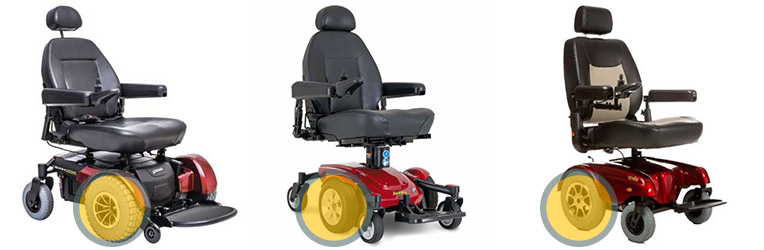
Each of these has distinct advantages and disadvantages.
The biggest advantage of front-wheel drive chairs lies in the fact that they’re great at powering over obstacles like curbs. If you do a lot of driving around in town and face curbs regularly, then front-wheel drive is probably your best option.
Front-Wheel drive chairs are also great for outdoor use because obstacles can take many forms besides curbs, and the same basic thinking applies. Powering over rocks and irregularities in the terrain just tends to be easier with a front-wheel drive model.
Center-wheel drive chairs are your best bet if you spend most of your time navigating tight, constricted spaces. If you live in a smaller home or apartment and you just don’t have much room to maneuver, these chairs are probably the best fit for you.
Rear-wheel drive chairs shine on hilly terrain that offers relatively flat (obstruction-free) surfaces for driving.
It should also be mentioned that both front and rear wheel drives tend to offer a smoother ride than their mid-wheel cousins.
Power Wheelchair Pivot Points 101
Let’s start with the basics:
What is a wheelchair’s pivot point?
Simply put, it is the point of intersection between the drive wheel axle line and the powerbase’s centerline.
Here’s a picture to demonstrate:
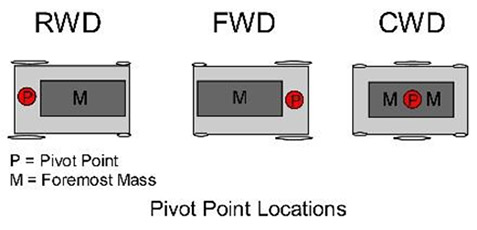
As you can see, most of the mass is in front of the pivot point on a rear-wheel drive chair. On a front-wheel drive chair, most of the mass is behind it, and on a Center-Wheel drive chair, it’s right in the middle where you’d expect to find it.
By itself, though, knowing that isn’t very helpful, so let’s give it a real-world example and see what the differences are.
Imagine that you’re driving down a hallway, and the hallway turns to the left. You’re in your chair, and you’ve got to navigate a 90-degree turn.
What do you do?
Well, you do this:
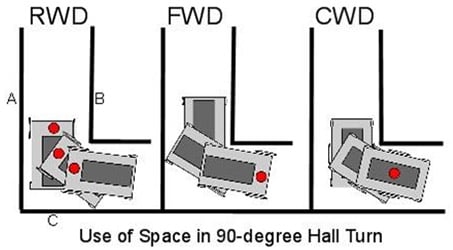
With a rear-wheel drive chair, you’ll need to pull to the right side of the hall to make the turn (the outside edge). With a front-wheel drive chair, you’ll need to veer to the left (the inside edge) of the turn, and with a mid-wheel drive chair, it doesn’t matter. If your chair will fit in the hallway, you already know you can make the turn!
The reason you need to pull to the outside of the turn with a rear-wheel drive chair is that you’ve got to give the front end more space to make the turn. The same thing is true with veering right (inside) if you’re driving a front-wheel drive chair – you’ve simply got to give the back end enough room to make the turn, or you’ll get yourself stuck and have to execute a multi-point turn.
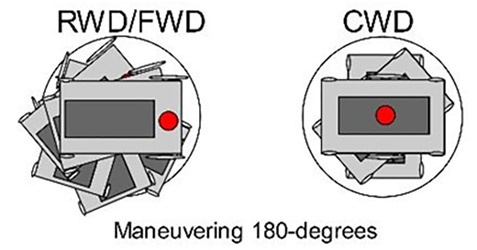
Here’s another feature of drive wheel placement you may not have been aware of: Drive wheel placement impacts turning radius.
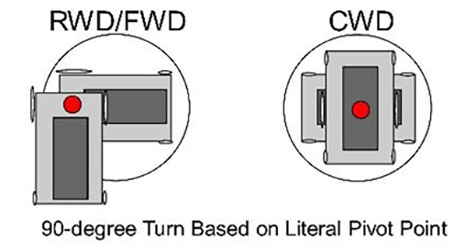
Take the example of a center-wheel drive chair that measures 40” in length. That chair will require exactly 40” to turn in place because that’s the length of the chair.
That’s not the case with front or rear-wheel drive models. Both will inevitably need a bit of “extra” room to execute a 360-degree turn.
Note that that’s also true for 90-degree and 180-degree turns.
By design, a mid-wheel drive chair is just better at turning. Here’s a quick illustration on that point:
Final Thoughts on Wheelchair Pivot Points
Well, simply put, it means that not all power chairs will work equally well for you. Some care and consideration are needed in terms of how you’ll be using the chair and what types of terrain you’ll find yourself in the majority of the time. The pivot point of the chair you’re using plays a bigger role in that consideration than you may have initially realized.
For instance, if you buy a rear-wheel drive chair and spend most of your time in town, you may find yourself frustrated beyond belief that the chair just can’t perform the way you need it to.
The same thing could happen if you spend money on a front-wheel drive chair to use mainly in your tiny home, and then, much to your dismay, you discover that you’re beating your walls to death because you can’t see what the back end is doing when you’re trying to turn, and more often than not, you collide with the drywall.
All that to say, it pays to really think about the settings you’ll primarily be using the chair in before you spend money on a power chair. Also, think about the pivot point of the chairs on your shortlist for consideration and how those pivot points will handle, given your predominant driving conditions.
Those who take such things into account before making a purchase will invariably wind up being more satisfied with their power chair than those who don’t.
At the end of the day, there are no “right” answers here. There’s no one “best” type of chair. It all comes back to how and where you’ll be using it!
Resources & References:
- Offset Pivot Wheelchair, REAR Lab.
- Mechanical Principles of Wheelchair Design, MIT.
- Pivot Turn of the Motorized Wheelchair, ResearchGate.