
Are you 100% happy with the versatility of your wheelchair? If you’re like most people, the answer to that question is almost certainly no. That’s true even if you absolutely love the current wheelchair you’re using.
The good news is that there’s a simple way you can increase the versatility of your trusty chair, and portable wheelchair ramps can get you there!
If you hadn’t considered incorporating a portable ramp into your mobility tech mix, then this article is almost certain to pique your interest. Let’s take a closer look at how and why.
Portable Ramps – Initial Considerations
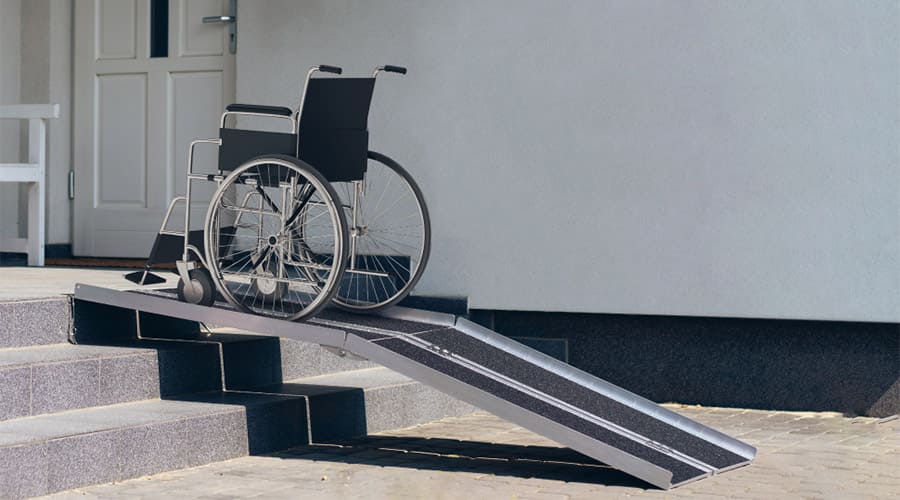
Here’s something you almost certainly already knew about wheelchairs. They don’t do well on stairs. Even a few steps leading up to a front porch can represent an impenetrable barrier to someone with a wheelchair.
Ramps change that equation, but there’s a catch. Regardless of whether you’re using it to navigate to your front door or to get your trusty wheelchair in and out of the back of your van, there are a couple of key measurements you’ll need to get a handle on.
Portable Home Ramp Width
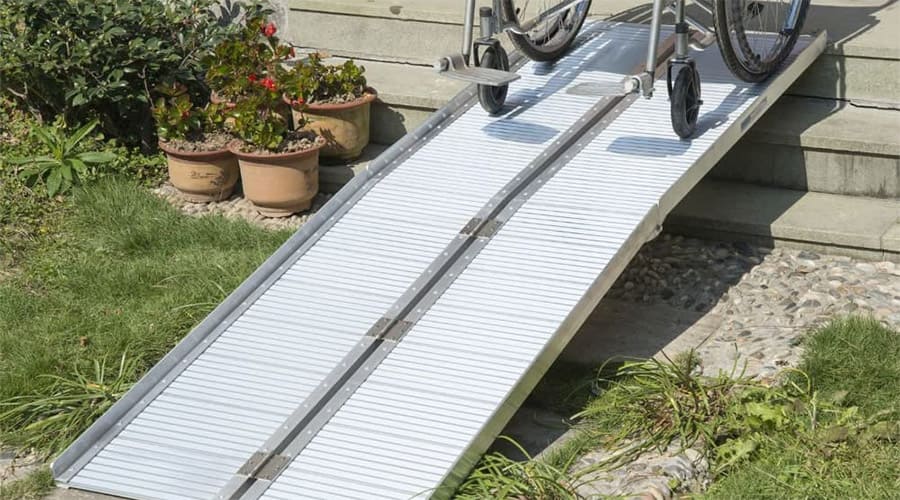
The first and most obvious is the width of the ramp you’ll need. That’s usually a pretty easy number to arrive at because the ramp needs to be at least a bit wider than your chair. If it isn’t, then it’s simply not going to be able to help you.
Things do get a little more complicated if you’re considering buying a Track Ramp, a two-piece ramp with a separate “track” for the right and left sides.
While these ramps work for a wide range of wheelchairs, they introduce some potential complications, especially where power chairs are concerned. You’ve got to keep not only the width of the drive wheels in mind but also the position of the casters and how much offset there is between them and the drive wheels.
Portable Access Ramp Length
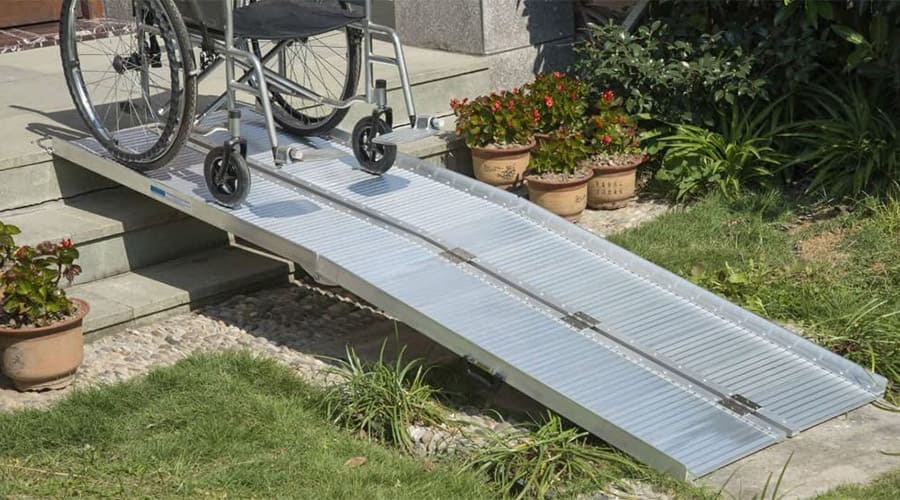
The other key figure is a little harder to arrive at, and that is the length of the ramp. Here’s the issue: The shorter the ramp, the steeper the angle will have to be. At a certain point, it’s going to be too steep to use.
So what’s the magic number? Surely, someone has already worked out the optimal angle, which would make it quick and easy to find the length you need, right?
As it turns out, that is indeed the case! When the Americans with Disabilities Act was passed, it established standards that go a long way toward answering this very question. Here’s what the Act has to say on the matter:
A ramp should be 12” long for every 1” of rise. That 1:12 ratio is the key bit.
Of course, this standard only applies to public ramps. You don’t have to abide by this standard when buying a ramp for home use. It’s your property, so you can do what you want. The problem is that many homeowners may not have sufficient room to build or buy a ramp to ADA standards. If that’s the case, then you’ve got to work with the space you have, whether it aligns with the ratio above or not.
There are a couple of other considerations here as well. If you’re using a manual wheelchair, you’re probably going to want to stick as closely to the 1:12 ratio as possible because as the angle of incline increases, so will the amount of work required to roll up the ramp.
On the other hand, if you use a powerchair, you won’t have to worry as much about the angle. However, it still matters to a point because as the slope increases, it becomes increasingly difficult to navigate safely when coming down the ramp.
For that reason, we wouldn’t recommend exceeding a ten-degree slope. It’s just not worth the risk, and most power chairs are designed to handle no more than a six percent slope in any case (though you will find some that are capable of handling up to ten).
To summarize then: In general, it’s easier for homeowners to abide by the ADA’s recommendations where portable wheelchair ramps for steps are concerned because most houses are built on a property with a space for a ramp long enough to abide by the 1:12 ratio.
People who live in apartments may not be able to employ a ramp at all, and as such, will, at least in most cases, be restricted to first-floor apartments unless the building has a reliable elevator.
When shopping for a portable wheelchair ramp for a minivan, you’ll probably need to get something shorter than the ADA recommends unless you can guarantee ample space in a parking area to allow you to use a ramp long enough to maintain that ratio. Here, just be mindful of the angle of incline as we described earlier.
Portable Wheelchair Ramps: Different Folding Options Available
The key to portability is whether a ramp can be easily transported, so ramps come in a variety of storable forms.
Single-fold ramps are folded in half, down the middle. They maintain 100% of their length, but the width is reduced by 50%. Thus, a 6”x30″ ramp folds down to a 6”x15″ for transport.
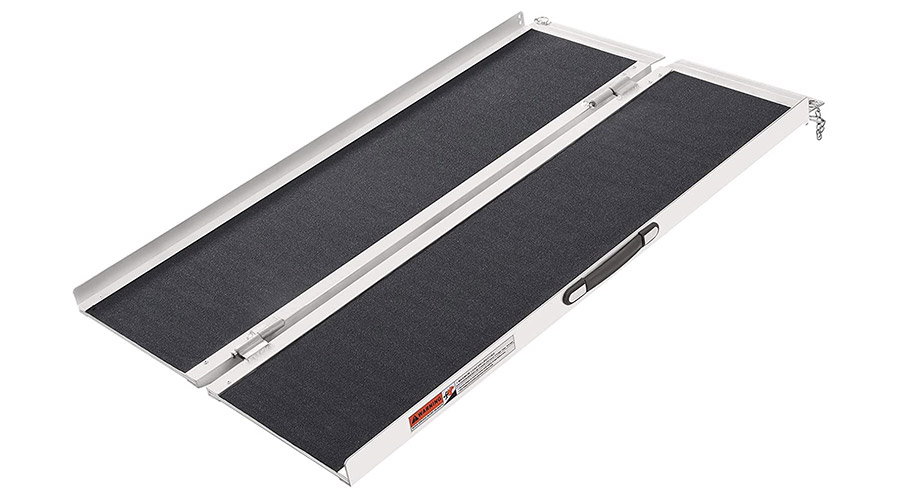
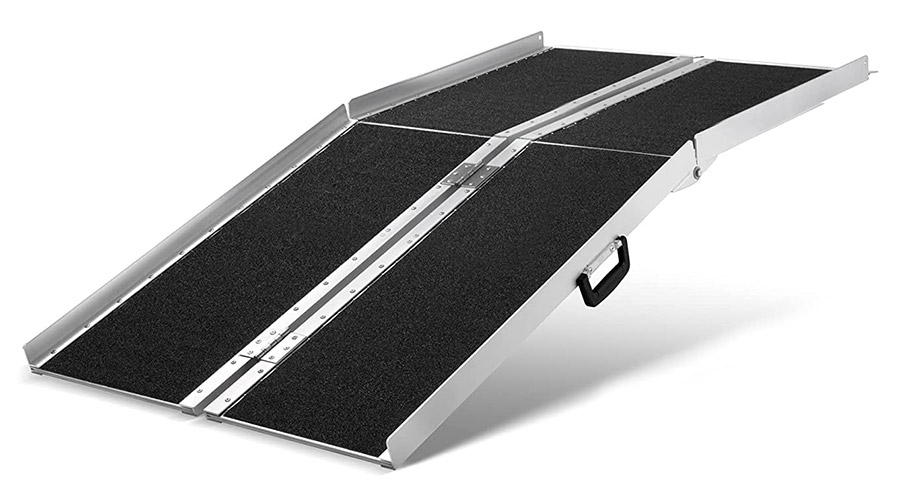
Multi-fold ramps (sometimes referred to as ‘suitcase ramps’) are folded down in both directions, length and width. Thus, a 6”x30″ ramp will fold down to just 3”x30″ for transport.
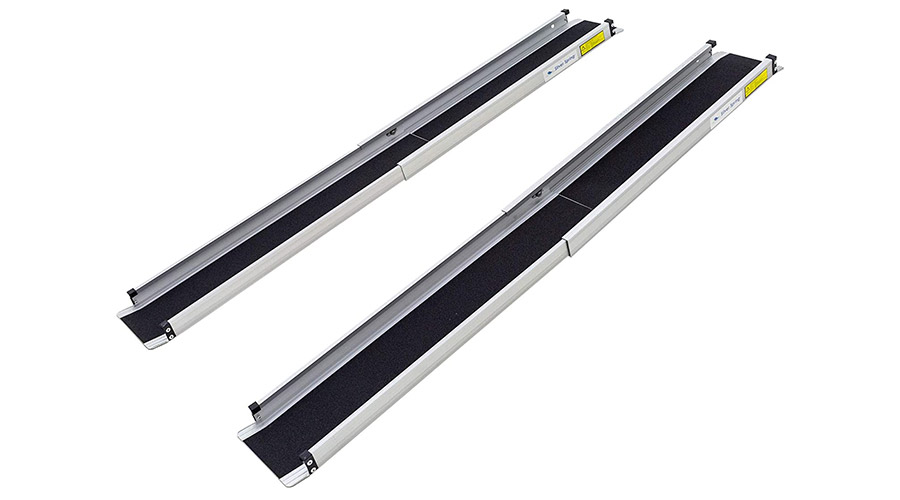
Telescoping track ramps don’t fold at all, but instead, slide into themselves. This action can reduce the overall length of the ramp by up to one-third, but does not change the width of the ramp (though these ramps do taper and are slightly slimmer at the end than they are at the base – they have to be in order for the telescoping action to work!
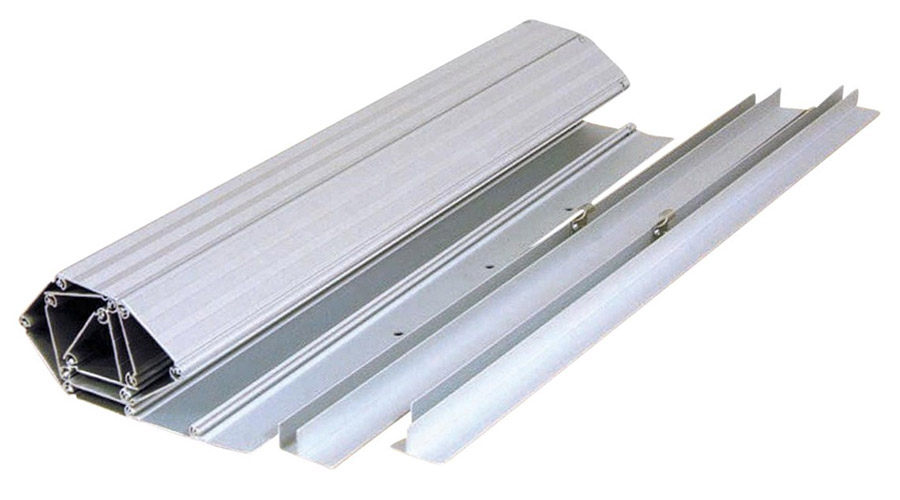
Finally, roll-up ramps feature rigid side rails that can be removed, allowing the segmented central surface to be “rolled up.” This essentially works like a rolltop desk.
Unfortunately, it sounds a lot cooler than it is in practice. These types of ramps can be frustratingly difficult to assemble, which makes them annoying to use.
In practice, a solid majority of users tend to prefer multi-fold ramps simply because they can be folded into a smaller footprint for travel and transport.
Mounting Styles

Where portable ramps have mounting styles, they’re designed for quick attachment and quick release. Ramps that are designed to be used in a particular environment or location (say, a portable ramp you use to help get your chair into and out of the back of your pickup truck) feature mounting points, which typically take the form of simple holes, strategically drilled into the side rails of the ramps).
Note that many manufacturers offer a semi-permanent solution in the form of brackets. So if you buy a portable ramp, you can semi-permanently mount it to your van to facilitate moves into and out of it, which is handy.
Weight Limits

There’s not much to say on this topic, but it did deserve a brief mention. Almost every ramp on the market today, from a portable wheelchair ramp for an SUV to portable wheelchair ramps for home stairs, is made of some kind of metal, usually aluminum, galvanized steel, or some type of alloy.
While it’s possible that an experienced DIYer could craft a workable ramp from wood, it wouldn’t last as long and wouldn’t support as much user weight. Given those facts, it’s not recommended.
As to the commercially available (mostly metal) ramps, just about every ramp on the market today is sold with reference to its maximum supported weight limit.
Take these numbers seriously, and be sure you don’t exceed them. Remember to take into account both your weight and the weight of the chair. In cases where you’re getting a boost from an attendant, be sure to factor in the approximate weight of that person and add 25-30% as a cushion, using the sum of those numbers as the weight limit of the ramp you want to buy.
Final Thoughts on Portable Ramps For Wheelchairs
Portable metal ramps (and again, most of them are metal) are relatively inexpensive accessories. Sure, you can find some deluxe, more expensive options, including a few portable ramps with handrails that you’ll pay a pretty penny for if you decide to make the investment. Still, generally speaking, a basic portable ramp isn’t something that will bust your budget.
Given that, many people wind up getting more than one. You’ll find some options marketed as portable wheelchair ramps for homes, while others are marketed as portable wheelchair ramps for minivans or other vehicles.
Humans have been using ramps since the building of the pyramids, and maybe even before that, so it’s well-understood technology. While there are a couple of important measurements involved in finding the right ramp for you, actually making use of your new ramp day in and day out is a lesson in simplicity.
In addition to that, there’s a lot of synergy between whatever type of wheelchair you use and a trusty ramp. Simply put, you’ll find that your chair is significantly more versatile with the inclusion of a ramp than without. They’re incredibly high-value investments.
Resources & References: