
Do you suffer from some type of mobility issue that sees you spending at least part of each day in a wheelchair?
Have you been trying to decide whether a power or manual wheelchair would be the best fit for you?
If you answered yes to the questions above, you might be very interested in learning more about power assist wheelchair devices. While they aren’t for everyone, when you finish reading this article, you may realize that they’re the perfect solution you’ve been looking for—the very best way to increase your mobility and increase your freedom and mobility.
If your interest is piqued, read on, and we’ll tell you what you’ve been missing out on!
What is a Power Assist Wheelchair?
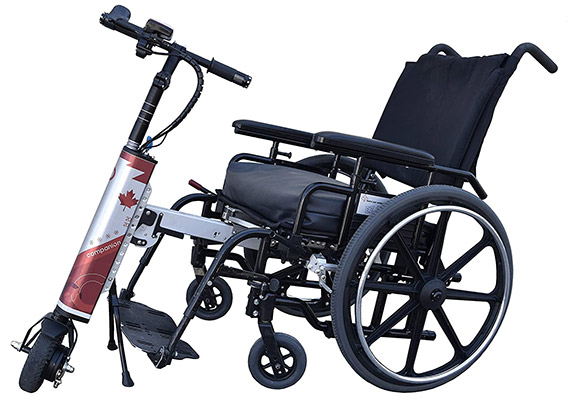
You can’t actually go to the store and buy a power assist wheelchair, as far as we know. What you can do is buy a good, lightweight manual wheelchair and outfit it with a wheelchair power assist device, which will provide you small bursts of power as you’re manually propelling your chair. The device will enable you to maneuver more easily and go longer distances without tiring yourself out.
This type of wheelchair is fundamentally different from an electric wheelchair, which tends to be bigger, heavier, and bulkier and also relies on a joystick control system for steering.
Contrast that with a chair outfitted with a power assist wheelchair attachment, which still relies on your arms for propulsion, but which gives you a battery- and motor-powered assist that allows each of your pushes to accomplish more work than they ever could on their own.
That’s the advantage.
That’s the value that power assist options for manual wheelchairs bring to the table.
It’s a compelling advantage because, according to recent surveys on the topic, more than 75% of manual wheelchair users complain of back and shoulder pain that arises as a consequence of using their chairs for extended periods each day.
This number rises to nearly 100% for users who have to travel relatively long distances in their manually propelled chairs or in areas that see them having to navigate hilly terrain regularly.
If that describes your situation, and you’ve been underwhelmed by the power wheelchair options on the market, then you may find power-assist devices for wheelchairs to be the perfect, middle-of-the-road solution.
How Does a Power Assist Device For a Manual Wheelchair Work?
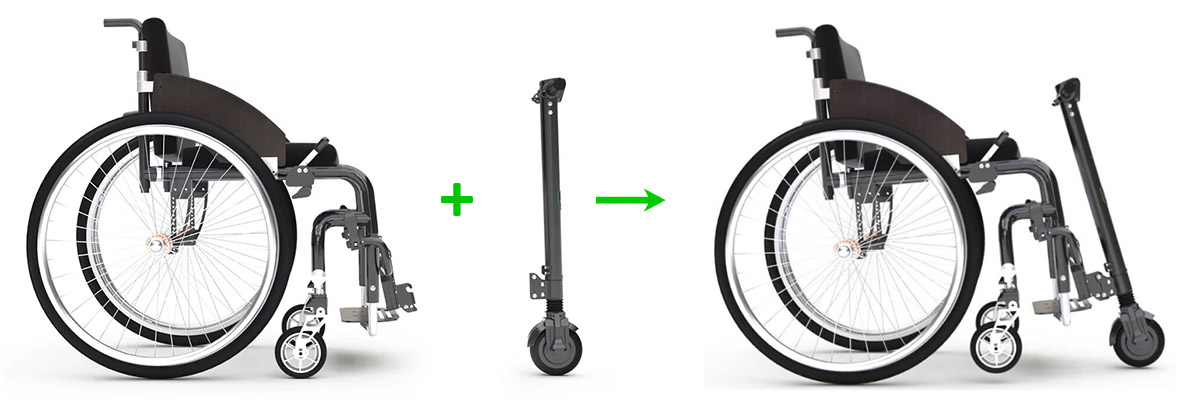
The answer to the question posed by the headline above is more interesting and complicated than you might think. For starters, the power for these devices comes from batteries, which tend to be smallish in size and fairly lightweight.
Power assist device manufacturers can get away with using smaller, lighter batteries with lower capacities because the power they provide isn’t constant. So you can expect that whatever form your power assist system takes, it will allow you to travel 9-12 miles before you need to recharge.
That’s enough range to get you through a busy day, but it’s not enough for most people to be able to go for several days between recharges. You’ll want to be mindful of where the nearest power outlet is so you can recharge as needed.
The science behind manual assist propulsion devices is fairly complex. It would be easy if all the motors needed to do were run continuously (which is the case when you’re riding around on a power wheelchair). Still, they only need to provide a boost in power when you actually use your arms to propel yourself forward.
That requires sensors and surprisingly delicate calibration. Even then, if you’re turning or trying to come to an abrupt stop, the technology may not cooperate fully, so this is by no means a 100% bulletproof solution. It’s got a few limitations, but the people who gravitate to this type of solution absolutely swear by it.
In general, the power assist wheelchair options available today provide about a 3:1 ratio of assisted power to the energy you provide manually.
Put another way, if you spend a full day in a conventional manual wheelchair, then you spend the following day in a wheelchair with power assist; you’ll only have to work about one-third as hard on the second day. One-third of the work means a lot less fatigue and far less strain on your arms, neck, and back, and who doesn’t want fewer aches and pains?
Even better, power assist technology added to your manual wheelchair will see your average speed increase from about 1.5 miles per hour to somewhere in the neighborhood of 4 MPH, which is on par with the speed of most of the electric wheelchairs on the market today.
Power Assist Devices For Manual Wheelchairs
Most of the power wheelchair attachments for sale today take the form of motors and batteries that attach to the wheels of your chair. One of the best in class examples of this type of product would be the Yamaha Navione. While Yamaha doesn’t have a long history in the wheelchair market, they know a lot about mobility in general, and this one is outstanding.
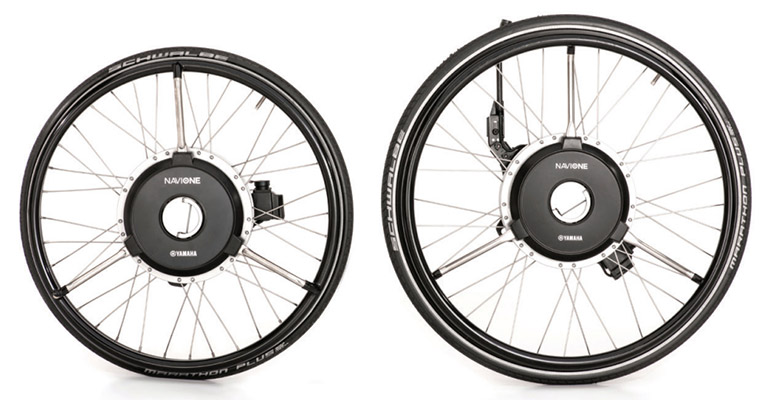
This is a manual wheelchair accessory push-rim activated power assist system that can get up to 22.5 miles to a charge if you buy the Lithium-Ion batteries rather than the nickel ones. The system can achieve a far greater range than just about anything else on the market today.
Other products, like the SmartDrive power assist module, are attached to the rear center of your chair. They work more or less the same way and provide the same benefit, but the engineering behind them is obviously quite different.
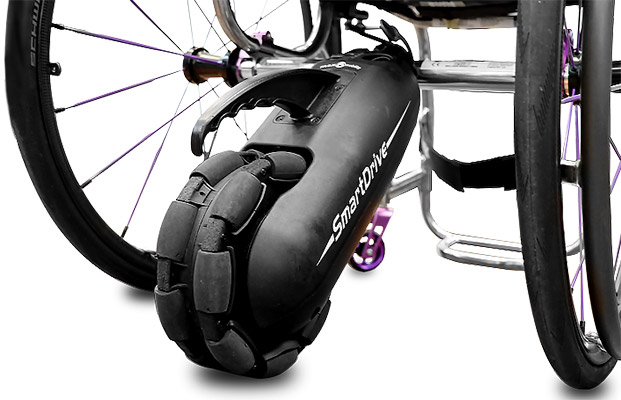
This one has the added advantage of coming with an app that tracks how many pushes you’ve made, how far you’ve traveled over the course of the day, and so on, which is surprisingly valuable information.
The two options above are what most people are looking for when it comes to manual power wheelchair technologies. Still, there are a number of small, nimble companies in this part of the market, and they’re coming up with all sorts of interesting (and useful) innovations.
One of our favorites is the Blumil Go, which mounts to the front of your manual wheelchair and basically turns it into an electric scooter. It’s one of the more expensive options, but it’s absolutely fantastic.
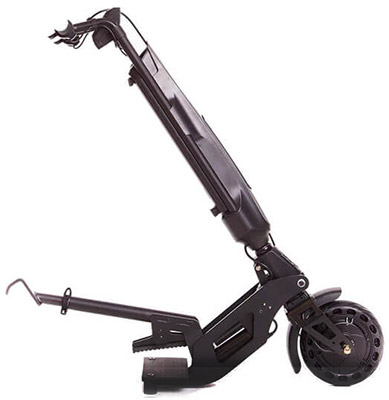
This one demonstrates just how far you can push the technology and what you can do with it.
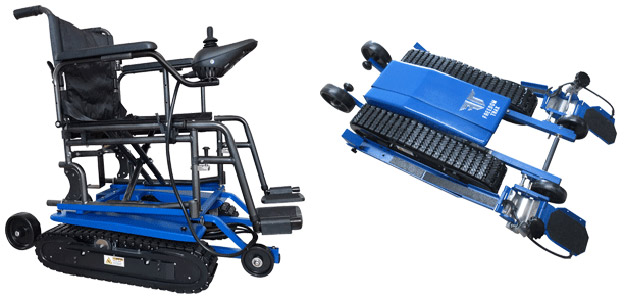
Another cool example is the FreedomTrax, which is a platform that essentially turns your wheelchair into an all-terrain vehicle. It’s another pricey option, but again, it’s much more than simple wheelchair power assist wheels added to your existing chair. This and the BluMil Go are end-to-end transformations.
We’ve gotten some questions about power-assisted stand-up manual wheelchair options. While we’ve found no aftermarket attachments that will convert a manual wheelchair to a standing variant, we found one exceptional manual standing wheelchair: The Leo II.
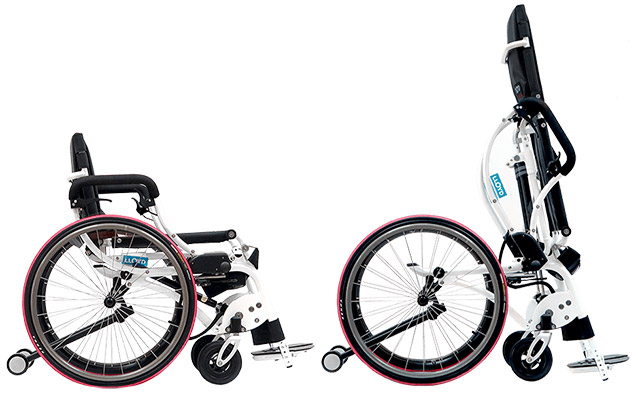
Most standing wheelchairs rely on an extensive array of motors to assist users in standing up. This one relies on you, specifically, the power of your arms. It’s a super innovative system that makes this one of the best values on the market, and it’s the least expensive standing wheelchair we’ve found to date. It’s absolutely superb.
What About Power Assist Wheelchair Weight?
No matter what option you select, adding batteries and motors to your manual wheelchair is going to increase its weight. This varies depending on exactly what you get. The most common variant, a manual wheelchair with power assist wheels, will add somewhere in the neighborhood of 35 pounds or so to the weight of your chair.
In most cases, that’s still less than what electric wheelchairs themselves weigh. Note that it is entirely possible to find good, lightweight, travel-friendly electric wheelchair options that weigh in the neighborhood of fifty pounds. So if every pound matters, something like that may be the better choice for you.
Are There Any Power Assist Wheelchairs With Joysticks?
Unfortunately, the answer to the question posed by this heading is no, at least not that we’ve seen for manual wheelchairs. Joystick controllers are quite common on power wheelchairs, but they’re just not something that we’ve seen manufacturers use on power assist technology for manual wheelchairs.
What About Cost?
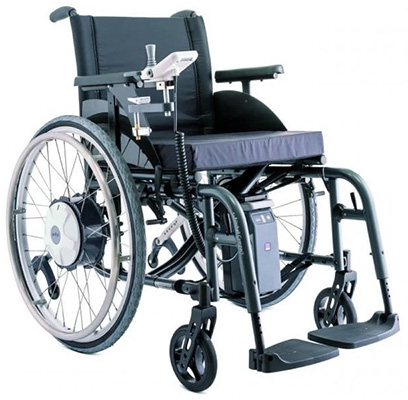
Power assist wheelchair costs vary widely, depending on exactly what you invest. In the overwhelming majority of cases, the simplest solutions are the least expensive and can be purchased for as little as a couple of hundred bucks in some cases.
The more transformational the solution, the more expensive it tends to be. Hence, something like the FreedomTrax is naturally a good deal more costly than power assist wheels for your wheelchair and can easily dwarf what you paid for the wheelchair itself.
At that point, the value proposition gets a bit harder to define. After all, if you’re going to spend hundreds and possibly thousands of dollars, why not just get a power wheelchair that you don’t have to propel manually?
Each person has a different threshold where that decision is concerned, but as the prices of augmentation options increase, at some point, everyone will cross that line.
Where Can I Find Power Assist Wheelchair Reviews?
You can find reviews for just about every product ever made, and a quick Google search of whatever specific product you’re interested in will no doubt yield at least a few results.
Bear in mind, however, that this is a small, niche market. You’re not likely to find hundreds or even scores of product reviews, but they are out there.
Final Thoughts on Power Assist Devices For Manual Wheelchairs
As you can see, there are tons of innovative power assist wheelchair options available today, from simple power assist wheels to much more advanced options that you may not have even considered that can completely transform the manual wheelchair you’re using right now, opening up worlds of new possibilities for you.
Are power assist wheels for your manual wheelchair right for you? Ultimately, that’s a question only you can answer. If you aren’t interested in an electric wheelchair, whatever the reason, but you still want a bit of a power boost, the technologies we’ve talked about here are great options to consider.
Resources & References:
- Justifying a Power Assist Device, Permobil.
- Perceptions of Power-assist Devices: Interviews With Manual Wheelchair Users, Taylor & Francis Online.