
NOTE: This article does not suggest or imply that power wheelchairs should be used in snow or any other adverse weather condition. This article is strictly for informational purposes. Users should follow the operational and safety guidelines found in the wheelchair owner’s manual from the manufacturer.

There are certain things you’ll have to go outdoors for though, for instance, driving from your front door to the car.
But the answer to this question is subjective, dependent on the expectations at play and the terrain. So before you start doing donuts outdoors, here’s what to know about using a power wheelchair in snow.
You know your wheelchair is not a snowmobile. In case you’ve been watching videos of powerchair users hurtling through 8” of snow like it’s Christmas morning, then we just want to give you a gentle reminder to steer clear of the hype.
Power wheelchairs are small, have casters, and have very little ground clearance. They are designed to be used indoors or on smooth pavement, not for galavanting in wet, slippery mounds of snow.
Following what you see in daredevil wheelchair videos is not a smart move and can prove dangerous or expensive if you damage your chair. The reality is that powerchairs should be kept indoors or at most on a cleared path when used outside.
How Deep of Snow Can a Power Chair Operate Safely?
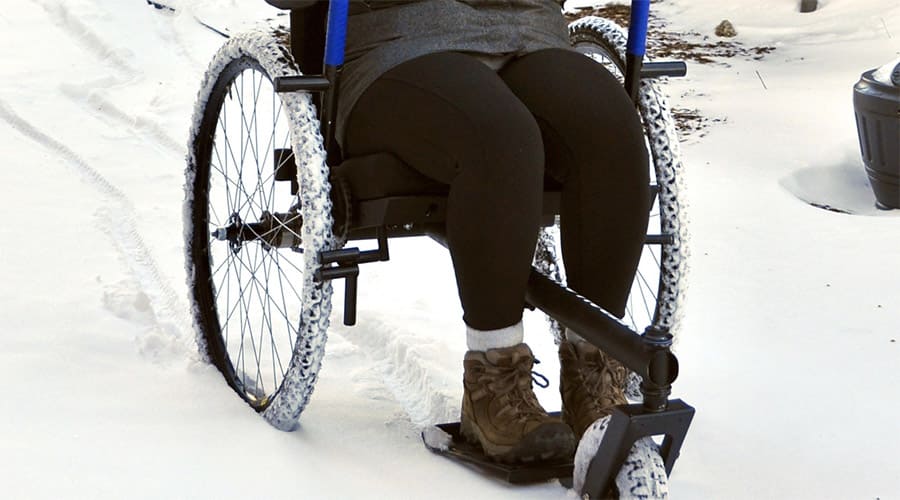
Now that we’ve gotten the formalities out of the way, it’s also realistic to note that if you live in a snowy region, it might be inevitable that you’ll have to roll outside to reach your van or mailbox daily.
The big question then is how deep in the snow can your powerchair go without issue?
Remember, this is highly subjective, depending on the make and model of your wheelchair. A full-size, high-performance chair might be able to make it through 3” of light, powdery snow on a paved surface.
If the snow is slushy with a high concentration of water, then your wheelchair will have a tougher time, even in 2” of snow.
That’s because the casters tend to bog down the unit, and the drive wheels cannot maintain proper traction. Sleet can cause a power wheelchair in the snow to slip, slide, or get stuck- especially on adverse terrain.
If you absolutely need to go outside, stay away from wet slush, stick to 3” of powdery snow on a paved, level surface, and move in straight lines and sweeping turns to avoid immobility.
Which Power Wheelchair Platform Performs Better in the Snow?
You might be wondering if one type of wheelchair platform (rear, center, or front-wheel drive) performs better in the snow over others.
In our experience, it’s about the same if you’re driving a high-end class powerchair. Remember that the most limiting components are lower ground clearance, small drive wheels, and casters, especially in Group-3 and 4 wheelchairs.
Bigger Wheelchair Tires are Better for Driving Through the Snow
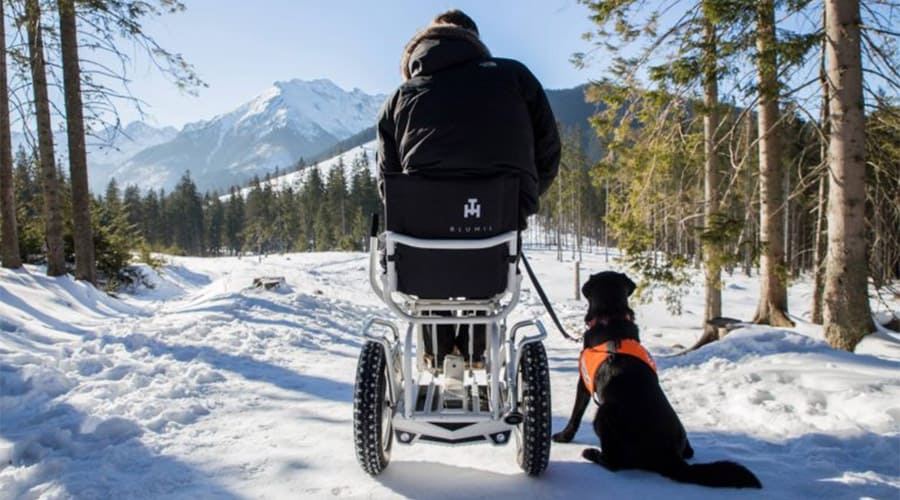
Unfortunately, the small build of a powerchair tends to sink effortlessly into any soft surface. They’re also high-centering. So if snow packs underneath the chair, the drive wheels spin, but lack the traction needed to move freely.
Drive tire size and tread make the biggest difference in how easily a powerchair can maneuver through the snow.
The larger and wider the tires are, the more stability your chair has to stay on top of the snow instead of sinking (remember, we’re talking 3” of snow max).
Standard powerchairs usually come equipped with 14” x 3” tires that sport a light tread pattern. However, you can upgrade to a 14” x 4” inch tire with a knobby tread to enhance performance in snow.
Bear in mind that while larger, wider tires increase traction, they are more cumbersome to handle, making indoor use challenging.
Be Careful With Salt and Slush on Pavement
In snowy regions, salt is used on walkways and driveways to melt the ice, creating a mushy slush that is a big no-no for powerchairs.
If you’re heading out onto a driveway or sidewalk, it’s imperative to be aware of wet, slushy snow, as the salt can be extremely damaging, causing rust to form on the components.
Power Wheelchair Safety in the Snow
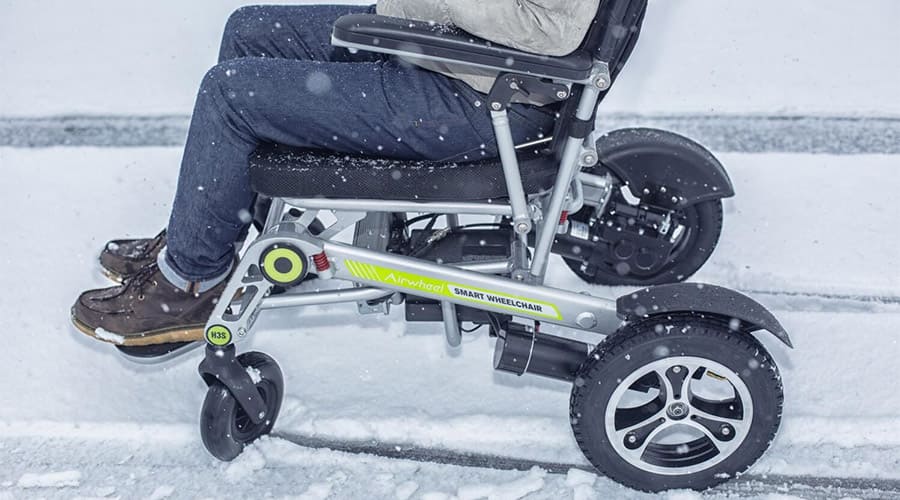
When the snow falls, it’s common for ramps and sidewalks to get blocked in by plowed snow, forcing wheelchair users to drive on the street.
Typically it gets dark earlier in the winter months. If you find yourself out and about when visibility is poor, then it’s paramount to take extra precautions.
Equip your powerchair with a tall, bright orange safety flag and don an orange safety vest or jacket that makes it easier for drivers to see you.
Also, think about safety gear when you’re on the road. Make sure you’re wearing multiple layers and water-resistant gloves to combat the cold and regulate your body temperature.
Make sure your cellphone is always fully charged before heading outdoors in case your wheelchair gets stuck. Always keep an eye on the weather if a storm is expected to hit, so you can plan your errands accordingly.
Watch the Batteries
Wheelchairs batteries just don’t hold up well in cold weather and lose the charge quickly.
Also, bear in mind that if you’re outdoors, you might go through your battery power faster than you’re used to, especially when moving over snow that forces your wheels to work harder.
Make sure to fully charge before hitting the streets and keep your cellphone handy for any issues you might encounter.
Avoid Moisture When Driving a Power Wheelchair in Winter
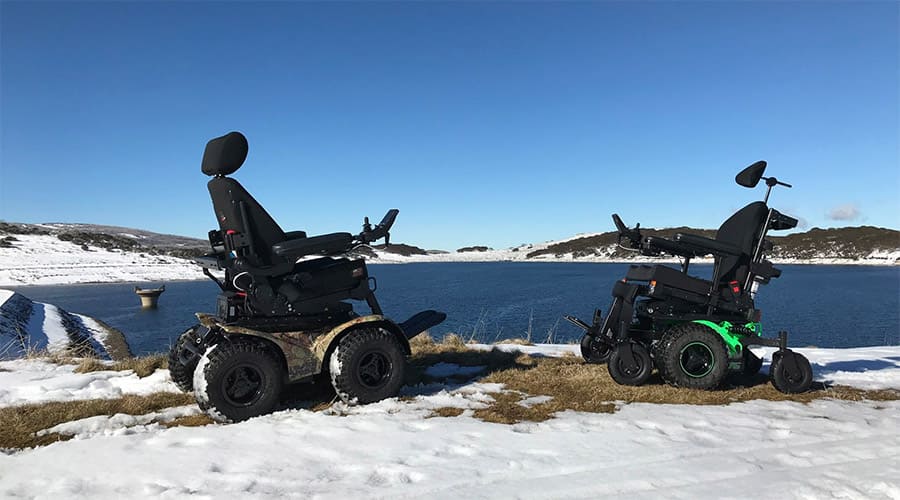
Moisture is not your best friend when out in the snow, so you’ll want to avoid build-up and slush, that if not promptly removed, can work itself into a delicate area and cause problems.
The joystick, in particular, is not waterproof and needs to be covered to prevent moisture from sneaking into the controls.
Joystick covers exist, or you can cover it with a plastic bag if you’re in a hurry.
Final Thoughts on the Use of Power Wheelchair in Snow
To conclude this article on the use of power wheelchairs in snow, the simple reality is that they are not designed to function in this type of weather.
Traction is an issue unless you have large, wide tires, and moisture is always risky business, especially for your joystick.
If you must go outdoors to get to your car or drive a short distance, then it’s best to maneuver through 3” of thin, powdery snow. Avoid salty slush and, most importantly, don’t follow those crazy videos and try any snowy stunts you’ll probably end up regretting!
Resources & References:
- Wheelchair Safety in the Snow, University of Utah Health.
- Wheelchair Snow Tires- an Easy and Inexpensive Do it Yourself Project, United Spinal Association.